














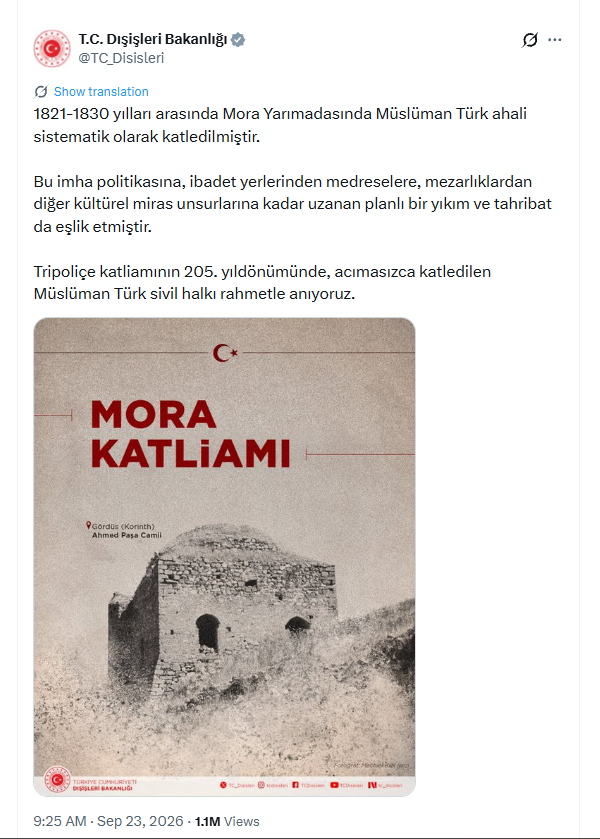
On 23 September 2026, Türkiye’s Ministry of Foreign Affairs commemorated the 205th anniversary of the massacre that followed the capture of Tripolitsa (Tripoliçe), the Ottoman administrative center of the Morea. This commentary builds upon this author’s earlier AVİM analysis of the Tripolitsa massacre, published during Greece’s 2021 bicentenary commemorations, which drew attention to the destruction of the Morea’s Muslim Turkish and Jewish communities and to the selective marginalization of their suffering in accounts of Greek independence.[1]
In a statement in social media, the Ministry recalled that “the Muslim Turkish population of the Morea (Peloponnese) Peninsula was systematically massacred between the years 1821 and 1830,” and that this violence was accompanied by a “calculated campaign of destruction” directed at places of worship, madrasas, cemeteries and other cultural heritage. It commemorated “the Muslim Turkish civilians who were brutally murdered”. [2]
Türkiye’s commemoration recalls a historical loss that has received strikingly limited recognition outside Turkish scholarship and public memory: the destruction of the long-established Muslim Turkish presence in the Morea during the Greek revolt. The victims of Tripolitsa were not an incidental footnote to the emergence of a new state. They were civilians whose deaths formed part of the violent disappearance of an Ottoman-Muslim society from the Peloponnese. The Ministry’s phrase “policy of extermination” is cited here as an official commemorative formulation, not as a legal conclusion by this author.
On the same day, unnamed Greek diplomatic sources, as reported by Kathimerini, rejected Ankara’s comments as a “systematic distortion and exploitation of history.” Yet the newspaper itself described the 1821 episode as an “atrocity against Turkish civilians” in which “thousands of Muslim and Jewish non-combatants were slaughtered.” The disagreement therefore concerns Ankara’s framing and terminology, not the existence of substantial civilian suffering. [3]
This exchange, coming nine days after Greece’s 14 September declaration on Asia Minor, shows again that historical remembrance requires completeness, conceptual discipline and legal precision. [4]
As this author’s 2021 AVİM analysis demonstrated, the present controversy should not be treated as an isolated diplomatic exchange. It reflects a continuing problem in the public memory of 1821: the tendency to commemorate the emergence of the Greek state while leaving the destruction of the Morea’s Muslim Turkish and Jewish communities outside the principal narrative of liberation. The issue is not whether Greek independence may be remembered, but whether historical commemoration can remain credible when it does not also acknowledge the civilian victims of its foundational conflict.[5]
The Historical Record of the Muslim Turkish and Jewish Victims
Greek commemorative practice marks the fall of Tripolitsa on 23 September 1821. Although the scale, chronology, and composition of the victims remain matters of historical discussion, contemporary and later accounts converge on extensive violence against Muslim and Jewish inhabitants following the capture. Thomas Gordon, a British officer who had served with the Greek insurgents, put the number killed at about 8,000.[6] The Greek historians Spyridon Trikoupis and Ioannis Filimon later wrote of about 10,000.[7] François Pouqueville, a philhellene whose Histoire de la régénération de la Grèce (1825) does not seek to excuse the episode, reported more than 16,000 dead.[8] William St Clair later summarised the slaughter as “upwards of ten thousand” people.[9] These figures are not identical. They are sufficient to establish that the capture was followed by extensive killing of non-combatant Muslim and Jewish inhabitants.
The Jewish community of the town was destroyed. Independent work by Steven Bowman records that destruction as part of the same collapse of the urban population.[10] Salâhi Sonyel’s study in Belleten documents the wider elimination of the Muslim Turkish presence in the Peloponnese between 1821 and 1830.[11] Maxime Gauin has usefully recalled that several Western volunteers in the insurgent forces later resigned and testified to the crimes they had seen; Gordon and Maurice Persat belong to that file. None of these sources originates in a Turkish ministry.
The 1948 Genocide Convention postdates 1821. The Convention’s legal test is not applied retrospectively here.[12] A commemorative vocabulary, whether “massacre,” “atrocity” or “extermination,” cannot substitute for that test.
Commemoration and the Erasure of Muslim Turkish Victimhood
The problem in public memory is not that Greeks remember the siege as a military turning point. It is that the second sentence is so often missing. On 28 September 2025, Defense Minister Nikos Dendias, representing the prime minister at celebrations in Tripolis, called the siege “the turning point that laid the foundations for the Greek Revolution,” because the fall “signified the collapse of the center of Ottoman rule and presence in Morea.” He added that Greeks “sensed a notion of a country in its cradle.” He recalled Kolokotronis and the plane tree on which Ottomans had hanged Greeks. He did not mention the killing of Muslim and Jewish inhabitants that followed the surrender.[13]
Diaspora practice follows the same architecture. At a wreath-laying in Melbourne on 28 September 2025, George Kotsirilos of the Panarcadian Association said the fall “was not just a military victory” but a blow to “Ottoman tyranny.” A year earlier, he said it “paved the way for the establishment of the modern Greek state.”[14] President Katerina Sakellaropoulou, in 2021, moved in one step from the town's strategic importance to Greece as “a modern state of law in the heart of the European Union.”[15] These texts attach the language of nation-birth to the capture. They do not mention Muslim or Jewish civilians. That is selective remembrance. It is not evidence that Greek statehood is “based on” a massacre.
Selective Memory, Anti-Turkism, and the Marginalization of Turkish Victims
The concern is not commemoration as such, but its conversion into a one-sided instrument. Official statements speak of “liberation” and the “cradle” of the nation. Parallel campaigns present 1922 and Pontus under the heading of genocide, while the civilian dead of 1821 remain off-stage. Street abuse directed at Turks, which resurfaced in replies to the Ministry’s post, is in a lower register and is not “the Greek position.” What travels into European debate is the cleaned official story: a foundational victory without Muslim or Jewish victims.
That pattern sustains a familiar anti-Turkish narrative in which Turks are portrayed exclusively as historical agents of oppression rather than also as civilian victims. It does not explain every form of contemporary anti-Turkism, but it provides a selective historical vocabulary through which such stereotypes can be repeated and normalized.
It treats Turks only as oppressors and never as civilian victims.
A principled rejection of hatred against Muslims and against Turks is inconsistent with that omission. Acknowledging Tripolitsa does not cancel Chios, Psara or other sites of Greek civilian suffering. It insists on one moral standard.
Tripolitsa should be remembered as a Turkish, Muslim, and Jewish human tragedy, not only as a Greek military success. Türkiye’s commemoration is therefore neither an attempt to deny Greek suffering during the war nor an invitation to cultivate inherited hostility. It is a call to recognize that the Muslim Turkish population of the Morea also had a history, a homeland, civilian lives, places of worship, cemeteries, and descendants of memory. Their disappearance cannot be excluded from the moral account of 1821.
Türkiye should respond through documentary scholarship, archival accessibility, translation, and principled public remembrance. European actors, meanwhile, should recognize that opposition to anti-Muslim hatred and anti-Turkism is not credible if Muslim Turkish civilian victims are excluded from historical memory. Remembering Tripolitsa responsibly means refusing to accept a hierarchy in which the humanity of victims depends on their religion, identity, or place in a preferred national story.
*Picture: X
[1] Teoman Ertuğrul Tulun, “Greece: 1821 Celebrations, Tripolitsa Massacre, BBC and Fake News,” AVİM Analysis No. 2021/12, 31 March 2021, https://avim.org.tr/en/Analiz/GREECE-1821-CELEBRATIONS-TRIPOLITSA-MASSACRE-BBC-AND-FAKE-NEWS
[2] Turkish MFA (@MFATurkiye), 23 September 2026; Turkish text: T.C. Dışişleri Bakanlığı (@TC_Disisleri), same date https://x.com/TC_Disisleri/status/2102645491158724869?s=20 . Reported in “Foreign ministry commemorates victims of Tripolitsa massacre,” Hürriyet Daily News, 23 September 2026, https://www.hurriyet.com.tr/dunya/disisleri-bakanligindan-tripolice-mesaji-musluman-turk-ahali-sistematik-olarak-katledilmistir-43316660
[3] “Athens rejects Turkish comments on anniversary of Tripolitsa atrocity,” Kathimerini, 23 September 2026, https://www.ekathimerini.com/politics/foreign-policy/1316097/athens-rejects-turkish-comments-on-anniversary-of-tripolitsa-atrocity/
[4] Teoman Ertuğrul Tulun, “Historical Memory, Legal Precision, and Selective Narratives: Greece’s 14 September Declaration,” AVİM Commentary No. 2026/51, 15 September 2026, https://avim.org.tr/en/Yorum/HISTORICAL-MEMORY-LEGAL-PRECISION-AND-SELECTIVE-NARRATIVES-GREECE-S-14-SEPTEMBER-DECLARATION
[5] Teoman Ertuğrul Tulun, “Greece: 1821 Celebrations, Tripolitsa Massacre, BBC and Fake News,” AVİM Analysis No. 2021/12.
[6] Thomas Gordon, History of the Greek Revolution (London, 1832). Gordon had served with the insurgent forces. On the value of Western volunteer testimony after resignation from those forces, see Maxime Gauin, posts of 26 July and 23 September 2026, pointing also to Maurice Persat, Mémoires.
[7] Spyridon Trikoupis, Historia tes Hellenikes Epanastaseos; Ioannis Filimon, Dokimion historikon peri tes Hellenikes Epanastaseos. Discussed in Salâhi R. Sonyel, “How The Turks of the Peloponnese Were Exterminated During the Greek Rebellion?,” Belleten 62, no. 233 (1998): 121–136.
[8] François Pouqueville, Histoire de la régénération de la Grèce, vol. III (Paris, 1825), 203. Pouqueville was a philhellene; the passage records the massacre without offering an excuse.
[9] William St Clair, That Greece Might Still Be Free: The Philhellenes in the War of Independence, 2nd ed. (Cambridge: Open Book Publishers, 2008), 43–46.
[10] Steven Bowman, “The Jews in Greece,” in Minorities in Greece, ed. Richard Clogg (London: Hurst, 2002).
[11] Sonyel, “How The Turks of the Peloponnese Were Exterminated.”
[12] Convention on the Prevention and Punishment of the Crime of Genocide, United Nations General Assembly Resolution 260 A (III), 9 December 1948, Articles I–II.
[13] Hellenic Ministry of National Defense, “Minister of National Defense N. Dendias attends celebrations for the Siege – Liberation of Tripolitsa,” 28 September 2025; parallel text at dendias.gr.
[14] Mary Sinanidis, “Honoring Tripolitsa: Arcadians gather at Hellenic War Memorial in Melbourne,” Greek Herald, 29 September 2025; “Panarcadian Association of Melbourne and Victoria celebrates 65 years,” Greek Herald, 15 October 2024.
[15] “Greek President Honors Fall of Tripolitsa,” Greek Reporter, 26 September 2021.
© 2009-2025 Center for Eurasian Studies (AVİM) All Rights Reserved
No comments yet.
-
 GERMANY’S EURASIAN OPENING AND ITS STRATEGIC BLIND SPOTS
Teoman Ertuğrul TULUN 08.09.2026 -
 THE NEW LEGAL BASIS FOR EU-ARMENIA RELATIONS
Teoman Ertuğrul TULUN 31.07.2018 -
 TÜRKİYE PROUDLY CELEBRATING THE CENTENNIAL OF THE SIGNING OF THE LAUSANNE PEACE TREATY
Teoman Ertuğrul TULUN 24.07.2023 -
 THE EUROPEAN PARLIAMENT RESOLUTION AND THE TERRORIST ATTACK AT CHRISTCHURCH
Teoman Ertuğrul TULUN 15.03.2019 -
 GREECE’S “CHERRY-PICKING” POLICY IN INVOKING THE RULES OF INTERNATIONAL LAW
Teoman Ertuğrul TULUN 31.08.2020
-
FORMER ARMENIAN FOREIGN MINISTER V. OSKANIAN IS INCRIMINATED
Alev KILIÇ 04.10.2012 -
 THE ‘ARMENIAN QUESTION’ IN UKRAINE - IV: THE PRUDENCE OF OFFICIAL KYIV
Turgut Kerem TUNCEL 17.05.2021 -
 AN OVERVIEW OF THE YEAR 2024
AVİM 31.12.2024 -
 COMMEMORATIVE STAMPS FOR GULBENKIAN
AVİM 19.04.2019 -
 THE EU'S POLICY IS STARTING TO OVERLAP WITH PASHINYAN'S STANCE
Hazel ÇAĞAN ELBİR 15.05.2024
-
25.01.2016
THE ARMENIAN QUESTION - BASIC KNOWLEDGE AND DOCUMENTATION -
12.06.2024
THE TRUTH WILL OUT -
27.03.2023
RADİKAL ERMENİ UNSURLARCA GERÇEKLEŞTİRİLEN MEZALİMLER VE VANDALİZM -
17.03.2023
PATRIOTISM PERVERTED -
23.02.2023
MEN ARE LIKE THAT -
03.02.2023
BAKÜ-TİFLİS-CEYHAN BORU HATTININ YAŞANAN TARİHİ -
16.12.2022
INTERNATIONAL SCHOLARS ON THE EVENTS OF 1915 -
07.12.2022
FAKE PHOTOS AND THE ARMENIAN PROPAGANDA -
07.12.2022
ERMENİ PROPAGANDASI VE SAHTE RESİMLER -
01.01.2022
A Letter From Japan - Strategically Mum: The Silence of the Armenians -
01.01.2022
Japonya'dan Bir Mektup - Stratejik Suskunluk: Ermenilerin Sessizliği -
03.06.2020
Anastas Mikoyan: Confessions of an Armenian Bolshevik -
08.04.2020
Sovyet Sonrası Ukrayna’da Devlet, Toplum ve Siyaset - Değişen Dinamikler, Dönüşen Kimlikler -
12.06.2018
Ermeni Sorunuyla İlgili İngiliz Belgeleri (1912-1923) - British Documents on Armenian Question (1912-1923) -
02.12.2016
Turkish-Russian Academics: A Historical Study on the Caucasus -
01.07.2016
Gürcistan'daki Müslüman Topluluklar: Azınlık Hakları, Kimlik, Siyaset -
10.03.2016
Armenian Diaspora: Diaspora, State and the Imagination of the Republic of Armenia -
24.01.2016
ERMENİ SORUNU - TEMEL BİLGİ VE BELGELER (2. BASKI)
-
AVİM Conference Hall 24.01.2023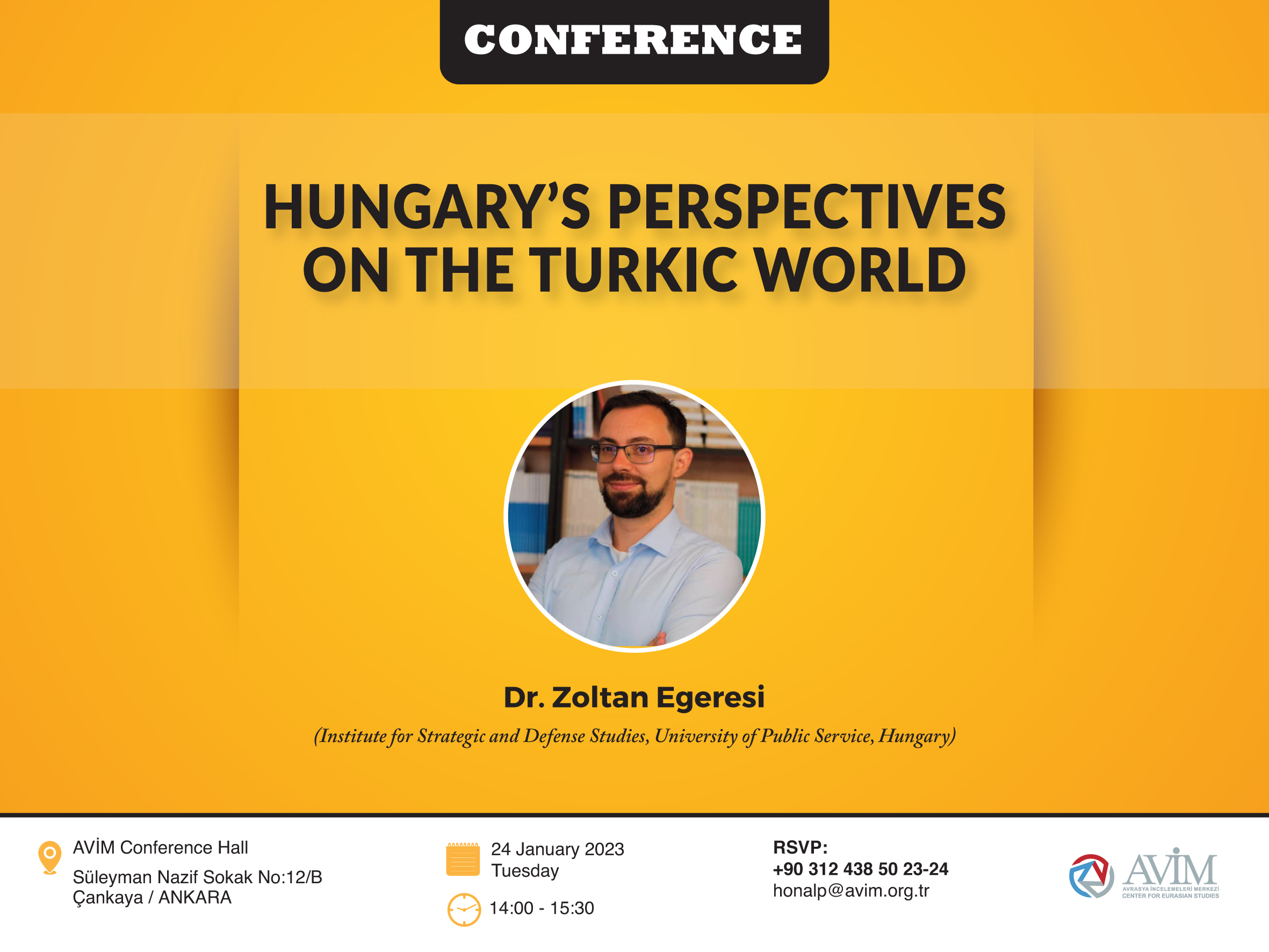
CONFERENCE TITLED “HUNGARY’S PERSPECTIVES ON THE TURKIC WORLD"