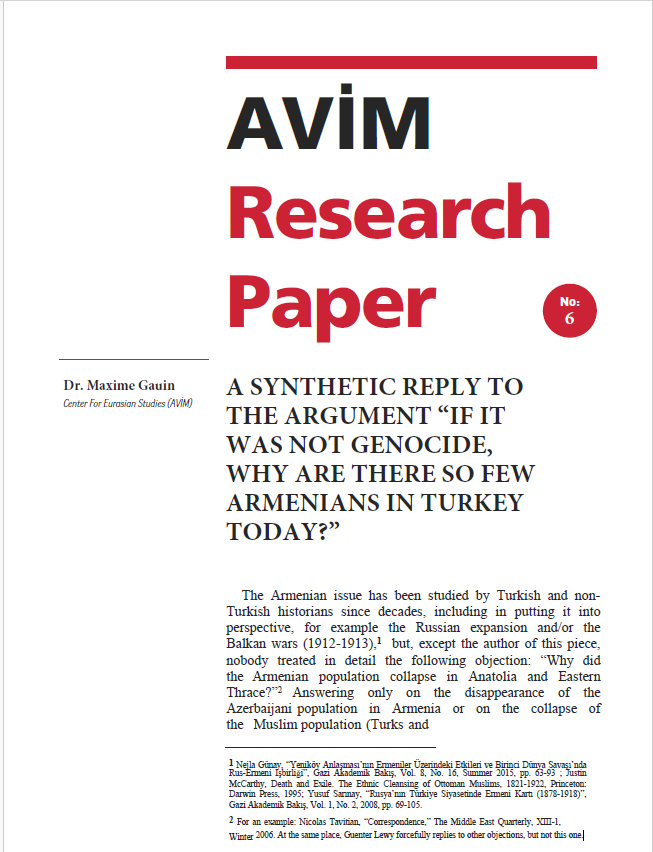















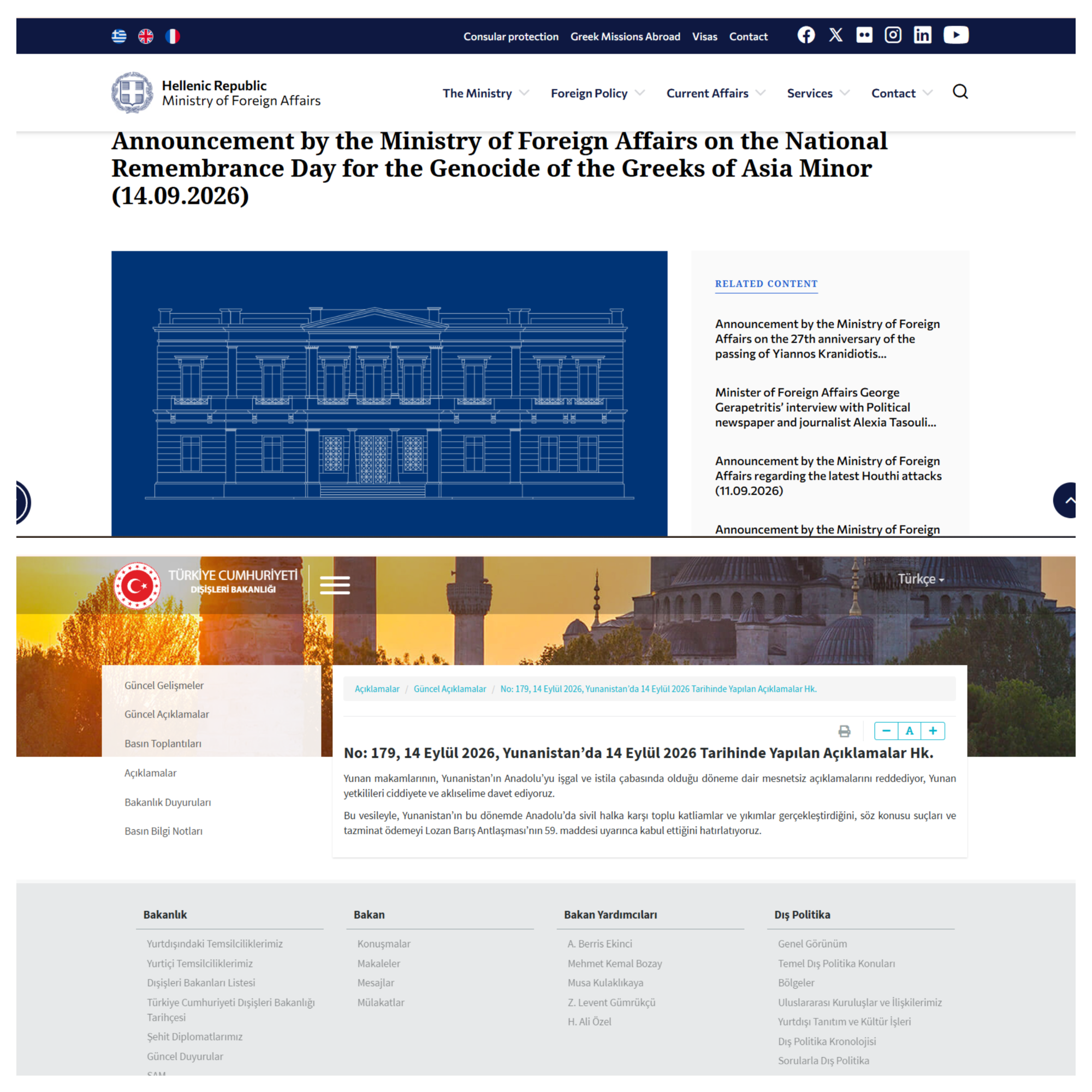
On 14 September 2026, the Greek Ministry of Foreign Affairs commemorated the National Remembrance Day for what it describes as the “genocide of the Greeks of Asia Minor,” associated with the 1922 destruction of İzmir.[1] Türkiye rejected the statement as unfounded and recalled Article 59 of the Lausanne Peace Treaty concerning Greece’s responsibility for acts contrary to the laws of war in Anatolia. This exchange shows that historical remembrance requires completeness, conceptual discipline, and legal precision.
The Historical Record of the Greek Occupation of Anatolia
The historical setting of the 14 September declaration cannot be confined to the events of September 1922. Greek forces landed at İzmir on 15 May 1919 following a decision of the Allied leadership at the Paris Peace Conference, and the landing developed into a Greek military occupation and advance in western Anatolia. Reports of violence prompted the Allied Powers to establish an Inter-Allied Commission of Inquiry in 1919. The Commission’s report recorded violence and pillage against Turkish inhabitants of İzmir on 15–16 May and found that Greek soldiers had participated, while military authorities had been late to restore order.[2]
A further Allied inquiry in 1921 concluded that, in the Greek-occupied parts of the Yalova–Gemlik area, Turkish villages were being destroyed and the Muslim population displaced.[3] Toynbee’s contemporary observations and these inquiries demonstrate that the period cannot responsibly be reduced to a one-sided narrative of victimhood.
The destruction of İzmir in September 1922, frequently invoked as the defining symbol of this period, must also be assessed in the context of the Greek army’s documented withdrawal strategy in western Anatolia, which involved the systematic destruction of numerous towns and villages. In this context, research by AVİM non-resident scholar Maxime Gauin, drawing on contemporaneous French, British, and American documentation, has challenged allegations of Turkish responsibility and advanced evidence pointing to Greek and Armenian responsibility for the fire.[4]
The Genocide Concept and the Lausanne Treaty Record
This documentary record also makes conceptual precision indispensable. The term “genocide” is not a general synonym for wartime suffering, forced displacement, or large-scale loss of life. Under Article II of the 1948 Convention on the Prevention and Punishment of the Crime of Genocide, it concerns specified acts committed with the intent to destroy, in whole or in part, a national, ethnic, racial, or religious group as such.[5] The Convention postdates the 1919–1922 conflict; it is therefore not invoked here retrospectively as a legal determination. A contemporary ministerial declaration cannot replace rigorous historical inquiry or legally disciplined assessment.
Article 59 of the Lausanne Peace Treaty records Greece’s recognition of an obligation to make reparation for damage caused in Anatolia by acts of its army or administration contrary to the laws of war. Türkiye subsequently renounced its claim for reparation in view of Greece’s financial situation.[6] This provision should also be read within the wider Lausanne settlement. The settlement restored the Karaağaç area, near Edirne, to Türkiye as part of the territorial arrangements agreed with Greece. Although Article 59 does not itself identify Karaağaç as compensation, the territorial transfer has been widely understood as connected to the reparations compromise reached during the Lausanne negotiations. The arrangement illustrates that the peace settlement addressed the consequences of the Greek occupation through concrete legal and territorial arrangements, not through a one-sided memorial narrative. A credible public discussion must acknowledge this record and the suffering of all civilian communities. [7]
Selective Historical Memory and Regional Dialogue
Against this background, the principal concern is not commemoration itself but the transformation of commemoration into a selective instrument of interstate discourse. When historical tragedy is presented through an exclusive and legally imprecise victimhood narrative, it risks entrenching antagonistic perceptions, marginalizing the documented suffering of other civilian communities, and diluting the meaning of atrocity-related legal concepts. Greece’s declaration invokes the duty to preserve memory and prevent falsification of history; those aims require inclusion of the occupation period and the contemporaneous international evidence concerning violence against Turkish and Muslim civilians.
Türkiye’s response, by recalling Article 59 of the Lausanne Peace Treaty, draws attention to a treaty-based dimension absent from that declaration. Official commemorative discourse should therefore be grounded in comprehensive archival research and legal consistency, while academic and public debate should recognize the suffering of all civilian communities without converting historical memory into a source of contemporary antagonism.
Ultimately, historical memory deserves respect only when it is comprehensive, evidence-based, and legally precise. Omitting documented violence against Turkish and Muslim civilians during the Greek occupation of Anatolia is incompatible with the principle that history must neither be erased nor falsified.
A balanced approach, attentive to the full historical and treaty-based record, is essential for scholarly integrity, reconciliation, and regional stability.
*Picture: Türkiye Ministry of Foreign Affairs and Helenic Republic Ministry of Foreign Affairs
[1] Hellenic Republic, Ministry of Foreign Affairs, “Announcement by the Ministry of Foreign Affairs on the National Remembrance Day for the Genocide of the Greeks of Asia Minor,” September 14, 2026, https://www.mfa.gr/en/announcement-by-the-ministry-of-foreign-affairs-on-the-national-remembrance-day-for-the-genocide-of-the-greeks-of-asia-minor-14-09-2026/ , accessed September 14, 2026
[2] Report of the Inter-Allied Commission of Inquiry on the Greek Occupation of Smyrna and Adjacent Territories, 7 October 1919, discussed by the Heads of Delegations of the Five Great Powers on 8 November 1919; see also Peter M. Buzanski, “The Interallied Investigation of the Greek Invasion of Smyrna, 1919,” The Historian 25, no. 3 (1963): 325–343.
[3] Reports on Atrocities in the Districts of Yalova and Guemlek and in the Ismid Peninsula, Cmd. 1478 (London: H.M. Stationery Office, 1921); Arnold J. Toynbee, The Western Question in Greece and Turkey: A Study in the Contact of Civilisations (London: Constable, 1922), 259–260.
[4] Maxime Gauin, “The Armenian Forced Relocation: Putting An End To Misleading Simplifications” Review of Armenian Studies 31 (2015): 93-131. A fuller academic study by Gauin, is Une Guerre a lueuer de L’incendie
[5] Convention on the Prevention and Punishment of the Crime of Genocide, adopted by United Nations General Assembly Resolution 260 A (III), 9 December 1948, Articles I–II
[6] “Lausanne Peace Treaty Part II. Financial Clauses” (Republic of Türkiye Ministry of Foreign Afairs, January 30, 1923), https://www.mfa.gov.tr/lausanne-peace-treaty-part-ii_-financial-clauses.en.mfa ; Republic of Türkiye Ministry of Foreign Affairs, “No: 179, 14 September 2026, Regarding the Statements Made in Greece on 14 September 2026, https://www.mfa.gov.tr/no_-179_-yunanistan-da-14-eylul-2026-tarihinde-yapilan-aciklamalar-hk.tr.mfa
[7] Prof. Dr. Hüseyin Bağcı and Dr. Teoman Ertuğrul Tulun, eds. The Lausanne Legacy: A Century Of Peace And Pathways To Tomorrow. Gazi Kitabevi, 2024
© 2009-2025 Center for Eurasian Studies (AVİM) All Rights Reserved
No comments yet.
-
 JOE BIDEN’S STATEMENT ON 1915 EVENTS: PURPOSEFUL POLITICAL ACTIONS MAY CAUSE UNANTICIPATED CONSEQUENCES, AN ANALYSIS FROM THE SOCIOLOGICAL VIEWPOINT
Teoman Ertuğrul TULUN 03.05.2021 -
 MONTREUX, CONSTRUCTIVE EURASIANISM, AND BLACK SEA STABILITY: REASSESSING TÜRKİYE’S STRAITS REGIME ON ITS 90TH ANNIVERSARY
Teoman Ertuğrul TULUN 22.07.2026 -
 POPE FRANCIS’ INTERVIEW: RELIGIOUS DISCRIMINATION AGAINST BUDDHISTS, SHAMANS, AND MUSLIMS IN THE HOPES OF CHRISTIAN UNITY
Teoman Ertuğrul TULUN 26.12.2022 -
 THE NEW LEGAL BASIS FOR EU-ARMENIA RELATIONS
Teoman Ertuğrul TULUN 31.07.2018 -
 EUROPEAN CURE=ARMENIAN AFFLICTION: PRONOUNCING HATE SPEECH UNDER THE GUISE OF NATIONALISM
Teoman Ertuğrul TULUN 09.10.2018
-
 IS THE THREAT POSED BY THE METSAMOR NUCLEAR POWER PLANT BEING OVERLOOKED?
Tutku DİLAVER 10.11.2022 -
 US PRESIDENT TRUMP’S STATEMENT
Aslan Yavuz ŞİR 26.04.2017 -
 ARCHITECTS OF DENIAL: THE LATEST CINEMATOGRAPHIC EFFORTS OF THE ARMENIAN LOBBY
AVİM 12.10.2017 -
 COMMEMORATIVE STAMPS FOR GULBENKIAN
AVİM 19.04.2019 -
 CONFERENCE ENTITLED “TÜRKİYE VE KORE: GELİŞEN AVRASYA’DA İKİ KÖPRÜ BAŞI” (TURKEY AND KOREA: TWO BRIDGEHEADS IN THE THRIVING EURASIA)
Vuslat Nur ŞAHİN 30.11.2017
-
25.01.2016
THE ARMENIAN QUESTION - BASIC KNOWLEDGE AND DOCUMENTATION -
12.06.2024
THE TRUTH WILL OUT -
27.03.2023
RADİKAL ERMENİ UNSURLARCA GERÇEKLEŞTİRİLEN MEZALİMLER VE VANDALİZM -
17.03.2023
PATRIOTISM PERVERTED -
23.02.2023
MEN ARE LIKE THAT -
03.02.2023
BAKÜ-TİFLİS-CEYHAN BORU HATTININ YAŞANAN TARİHİ -
16.12.2022
INTERNATIONAL SCHOLARS ON THE EVENTS OF 1915 -
07.12.2022
FAKE PHOTOS AND THE ARMENIAN PROPAGANDA -
07.12.2022
ERMENİ PROPAGANDASI VE SAHTE RESİMLER -
01.01.2022
A Letter From Japan - Strategically Mum: The Silence of the Armenians -
01.01.2022
Japonya'dan Bir Mektup - Stratejik Suskunluk: Ermenilerin Sessizliği -
03.06.2020
Anastas Mikoyan: Confessions of an Armenian Bolshevik -
08.04.2020
Sovyet Sonrası Ukrayna’da Devlet, Toplum ve Siyaset - Değişen Dinamikler, Dönüşen Kimlikler -
12.06.2018
Ermeni Sorunuyla İlgili İngiliz Belgeleri (1912-1923) - British Documents on Armenian Question (1912-1923) -
02.12.2016
Turkish-Russian Academics: A Historical Study on the Caucasus -
01.07.2016
Gürcistan'daki Müslüman Topluluklar: Azınlık Hakları, Kimlik, Siyaset -
10.03.2016
Armenian Diaspora: Diaspora, State and the Imagination of the Republic of Armenia -
24.01.2016
ERMENİ SORUNU - TEMEL BİLGİ VE BELGELER (2. BASKI)
-
AVİM Conference Hall 24.01.2023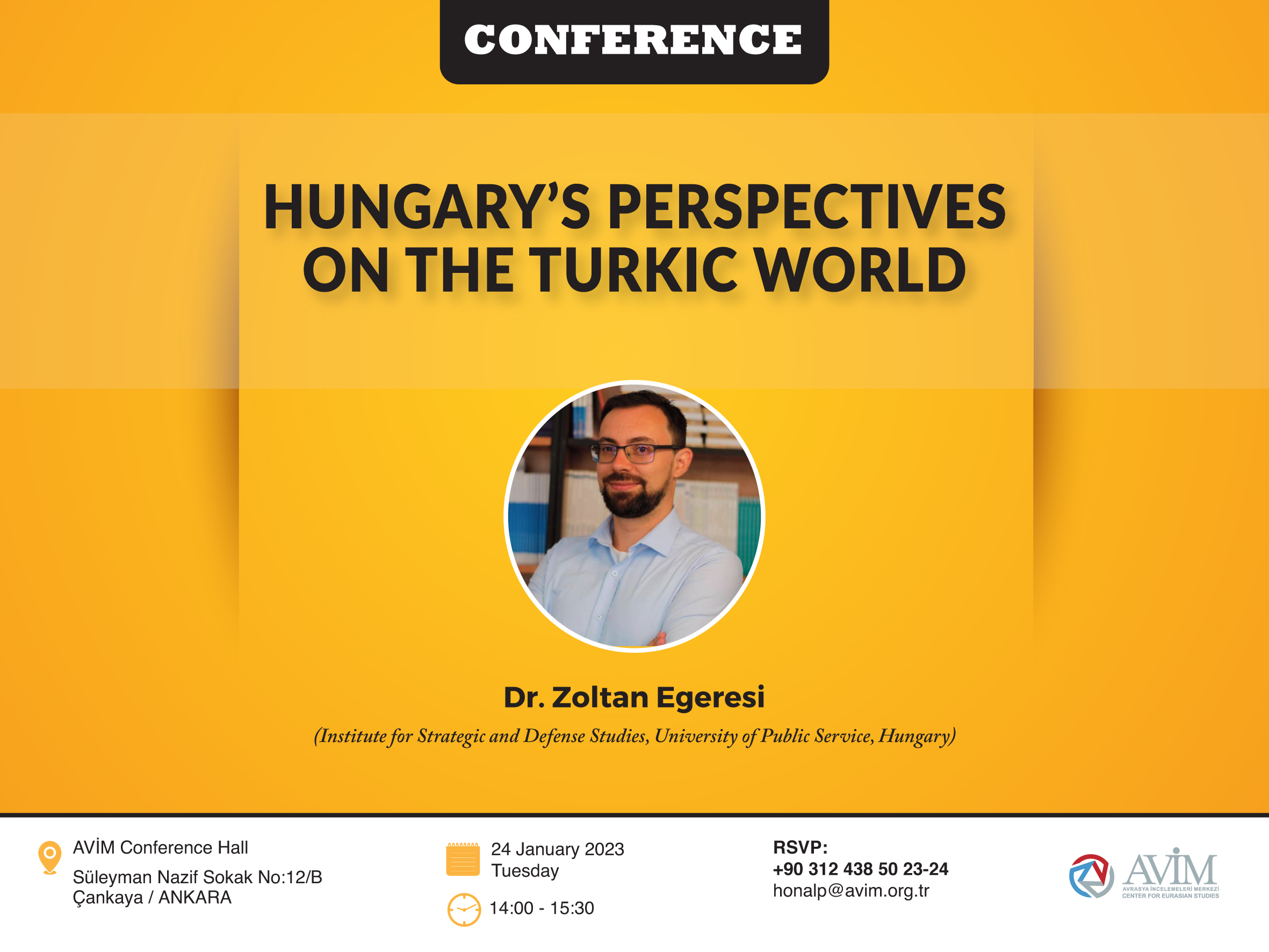
CONFERENCE TITLED “HUNGARY’S PERSPECTIVES ON THE TURKIC WORLD"