This is the English translation of a Turkish language article that was originally published by AVİM on 5 August 2026.
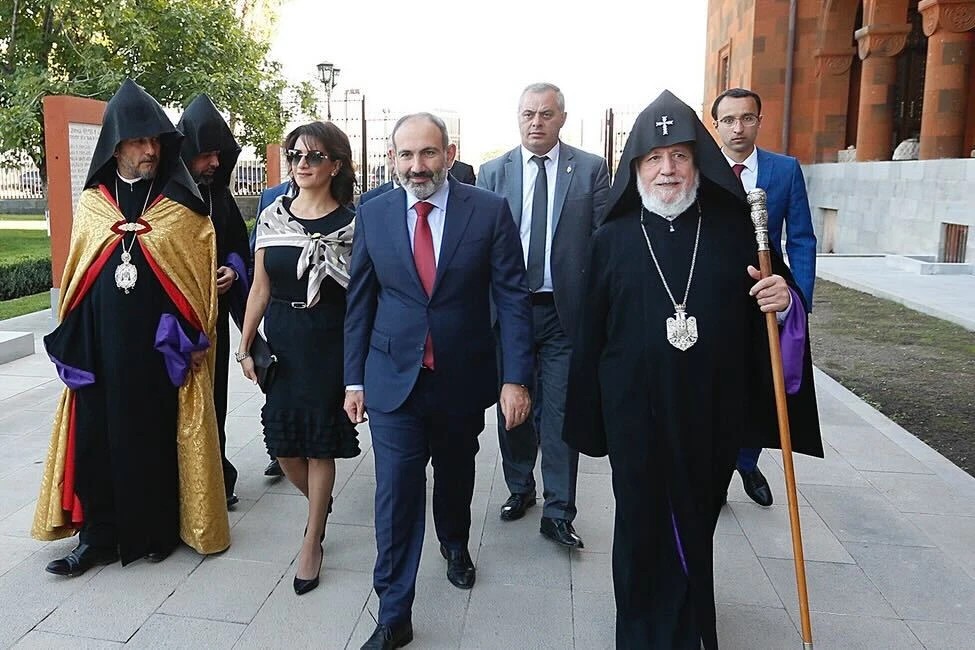
The ongoing tension between the government and the Church administration in Armenia remains a key issue on the agenda. Pashinyan’s re-election on 7 June and thus the public’s reaffirmed support for the recent reforms, particularly in light of the Armenian people’s attachment to the Apostolic Church, have marked a significant development in the context of this tension.
As is known, the criticism against Catholicos Karekin II started with allegations that he did not meet the requirements of his position. The criticisms continued due to his efforts to influence Armenia’s politics. Since the tensions first arose, neither the Catholicos nor Pashinyan have backed down, but the diaspora’s support for Karekin II has noticeably waned. Throughout the process, the Catholicos actively intervened in domestic politics, but also made significant efforts to involve external actors in the matter. Taking on the role of filling the void created by the ineffective politics of the opposition in Armenia, Karekin II has over time become the most active member of the said opposition. Throughout all these developments, the Catholicos has not been accused of interfering in state affairs or politics either by the opposition groups or by the radical-militant groups within the anti-government diaspora that provide material and moral support to the opposition. However, the recent trials against members of the Church in Armenia have suddenly led the opposition and radical groups within the diaspora to recall the relevant section of the Constitution of Armenia.
Article 17 of the Constitution of Armenia states that the freedom of activity of religious organizations is guaranteed by the Constitution and specifies that religious organizations shall be separate from the government. Article 18 states that the Apostolic Church is Armenia’s national church and recognizes and accepts the Church’s role in the preservation and development of culture and national identity. In addition, the Church’s spiritual role with respect to Armenian citizens is emphasized. According to the second paragraph, the relationship between the State of Armenia and the Apostolic Church is to be regulated by law.[1]
The law, which is in force with the title of “The Law of the Republic of Armenia on the Freedom of Conscience and on Religious Organizations”, acknowledges the status of “national Church” referred to in the Constitution, but also emphasizes freedom of religion and conscience. The law and the Constitution assert that freedom of religion and conscience applies to all religions within Armenia’s borders. However, it is observed that the Constitution and the special law conflict on this matter. For example, the law grants the freedoms to engage in missionary activities, open churches, participate in the education system, and conduct international activities within the country’s borders exclusively to the Apostolic Church.[2] The said law, which clearly observes a hierarchy between religions, mentions the Apostolic Church as the national church as in the Constitution, and positions it above other religious institutions in terms of the aforementioned freedoms of activity. In fact, the freedom to engage in international activities is linked to the status of national church; that is, the Church is granted the status of representing the Armenian people in an international context almost on par with the state of Armenia.
The explicit recognition of freedom of religion and conscience, the granting of the right to change one’s religion to individuals and the stipulation that religious organizations shall operate independently of state affairs do not demonstrate that Armenia is a secular country. As can be seen, the Apostolic Church has been granted numerous legal privileges and has even been given the right to intervene in the school curriculum. The Church’s inclusion in the education system, its status as the national church and the state’s discriminatory attitude in favor of the Apostolic Church in the context of religious organizations operating within the country are elements that clearly conflict with the concept of secularism. Given the existence of these elements, it cannot be claimed that Armenia is a secular country, nor can it be argued that the legal procedures carried out against members of the Church are contrary to secularism.
The active interference of Karekin II and his supporters in Armenia’s politics was not deemed justified in the context of freedom of activity even under the Constitution and laws that grant the Church numerous freedoms. Moreover, all the freedoms mentioned above can only be exercised in accordance with the law, as long as they do not violate the legislation in force.[3] Making the Church independent in internal affairs does not mean permitting a structure that is not subject to domestic law and one that has its own set of rules. As can be seen, Karekin II and his supporters are the ones who have been violating the Constitution and relevant laws from the very beginning. Given this situation, it does not appear to be in goodwill to raise claims of unconstitutionality regarding the prosecution of Church members while Karekin II, who has clearly assumed the role of an opposition figure, is not mentioned. This situation stands as yet another example of the misinterpretation of constitutional provisions in Armenia, deviating from their intended purpose.
In conclusion, although there is a constitutional provision stating that religious organizations are entities independent of the state; the national status of the Apostolic Church, the privileges granted to it under special laws, and the relationships observed in practice all demonstrate that Armenia is not a secular country. It is pointless to allege a violation of the principle of secularism in a country that is not secular. Furthermore, Karekin II and his followers are clearly exercising a freedom (actively intervening in politics) not recognized in the Constitution or in special laws and are thereby violating the relevant legislation. It should be emphasized that the Church’s interference in politics and the opposition’s allegations of violations of secularism stand out as one of the key decision points for amending the Constitution of Armenia or drafting a new constitution. For this reason, the constitutional amendment process in Armenia is becoming ever more important as an essential factor in terms of political stability, and the effective implementation of laws and social harmony in the country.
*Image: Agos
[3] “The Law of the Republic of Armenia on the Freedom of Conscience and on Religious Organizations”, m.17.
© 2009-2025 Center for Eurasian Studies (AVİM) All Rights Reserved
















 THE LATEST SITUATION IN ARMENIA PRIOR TO THE ELECTIONS
 THE ORGANIZATION OF TURKIC STATES AND THE CLAIMS OF TURANISM AND PANTURKISM
 SWITZERLAND'S BIASED STANCE AND ITS HARMFUL EFFECTS ON PEACE EFFORTS - 2
 THE ISRAELI CABINET’S DISTORTION OF THE FIRST WORLD WAR EVENTS AND PASHINYAN’S STATEMENTS
 THE EU'S REFUGEE POLICY IN LIGHT OF VON DER LEYEN'S VISIT TO EGYPT AND THE CASE OF RWANDA
 TAIWAN’S POLITICAL TURN: TSAI ING-WEN’S ELECTED AS THE PRESIDENT OF THE REPUBLIC OF CHINA
 OBSTACLES TO PEACE BETWEEN AZERBAIJAN AND ARMENIA
 THE UNSTEADY SOUTHERN CAUCASUS
 ARMENIAN GENOCIDE FILMS FAIL TO WIN ACCLAIM
 CALL FOR PAPERS: REVIEW OF ARMENIAN STUDIES