The brutal chain of assassinations launched by Armenian terrorists targeting Turkish diplomats during the 1970s and 1980s are still fresh in the memories of victims and their families. While these tragic events are studied and listed in detail, their precedents in history are not quite as well known. An interesting case in this regard was the experience of Mehmet Refet Bey, the Ottoman Consul for Batavia (modern Jakarta), during World War One (WWI).
Mehmet Refet Bey was an Ottoman Turkish diplomat who served his country with distinction and put his life on the line in order to have truth heard. He was born in Cyprus, and before being appointed as the Consul for Batavia, he served as Ottoman Consul in Batumi and Tbilisi. In March 1911, he was appointed as the Consul-General for Batavia and he would serve in this position until his return to Ankara in 1924. Therefore, Mehmet Refet Bey was in this post when the WWI broke out in the summer of 1914 and when the Ottoman Empire joined the war in October 1914.
During the war, the activities of Armenian nationalist inside the Ottoman Empire, especially those undertaken in conjunction with the Entente Powers, compelled the Ottoman government to take preventive security measures. As a result, the government issued “the Temporary Law on Transfer and Resettlement” of May 1915 and began to transfer the Ottoman Armenians mainly from Eastern Anatolia and other sensitive areas to parts of Syria and Iraq which were then still part of the Ottoman Empire. This decision and the tragic events that took place before and after this decision had been subject an extensive propaganda campaign by the Entente Powers to convince the American public opinion and the rest of the world that they were not fighting a war of aggression but a justified war against the Evil.
In line with this, the British set up a propaganda bureau, the infamous Wellington House, that routine sent one-sided and distorted reports intended to serve their political and military purposes. Accordingly, the British and American news agencies and newspapers were the main target of this propaganda campaign. During WWI, the Reuters, for example, “came under pressure from the British government to serve national interests.” It is little wonder that its reports, routinely spread to the world news outlets, contained a large number of unsubstantiated reports, half-truths and outright distortions in connection with the Ottoman Empire.
When the biased coverage of the Reuters reports reached Batavia, Mehmet Refet Bey as the Ottoman Consul had not remained indifferent and reacted promptly to issue refutations and corrections in the local Indonesian press. He noted the status of the Ottoman Armenians was by no means as negative as depicted by these agencies. The Ottoman government appointed Armenians to high positions; there were Armenian ambassadors, consuls and other diplomats. There Armenian deputies in the Ottoman Parliament and Armenian ministers in the cabinet. Thus, Mehmet Refet Bey tried to undercut the impact of the disinformation campaign, and his efforts made him a target for the Armenian nationalists.
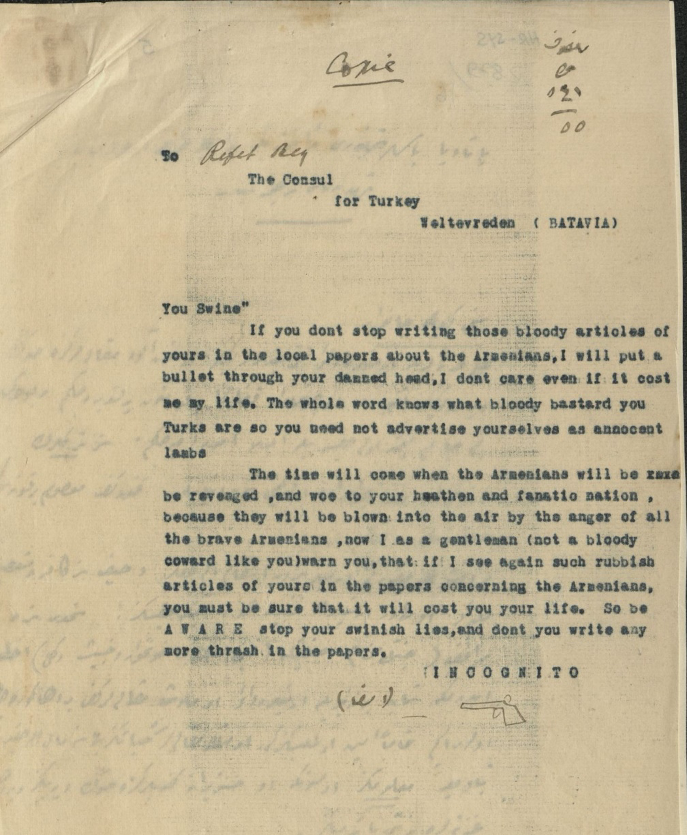
In 1916, he was sent an anonymous letter by an Armenian nationalist, threatening to kill him if he did not stop writing articles. The letter was signed by a coward terrorist who could not put his signature to it and instead signed as “incognito”. After issuing many threats and insults, letter ended a hand drawn gun, meant to intimidate Mehmet Refet Bey:
"To Refet Bey,
The Consul for Turkey, Weltevreden (BATAVIA)
You Swine,
If you don’t stop writing those bloody articles of yours in the local papers about the Armenians, I will put a bullet through your damned head, I don’t care even if it cost me my life. The whole word knows what bloody bastard you Turks are so you need not advertise yourselves as innocent lambs.
The time will come when the Armenians will be revenged, and woe to your heathen and fanatic nation, because they will be blown into the air by the anger of all the brave Armenians, now I as a gentleman (not a bloody coward like you) warn you, that: if I see again such rubbish articles of yours in the papers concerning the Armenians, you must be sure that it will cost you your life. So be AWARE stop your swinish lies, and don’t you write any more thrash in the papers.
INCOGNITO
[A Pistol Drawing]"
Never one to be intimidated by bullying and threats, Mehmet Refet Bey ignored the letter and continued to work for getting the truth heard. He asked the Ottoman government take care of his children and family in case something happened to him.
The incident is illustrative of the heroism shown by Turkish consuls in line of their duties. But it also attests to the fact that Armenian terrorism of the 70s and 80s were not an aberration but a merely ring in a long chain of Armenian nationalist terrorist tradition that up till today did not receive the condemnation it deserves.
















 UNITED STATES OF AMERICA CONTINUES ITS HABITS
 THE MANAGEMENT BLUNDERS IN THE EU
 ECHR’S DOĞU PERINÇEK - SWITZERLAND DECISION (UNOFFICIAL ENGLISH)
 ARMENIAN TERRORISM BEGINS TO SHOW ITS FACE AGAIN - 2
 REFLECTIONS ON THE EU – CENTRAL ASIA SUMMIT
 THE KARABAKH CONFLICT AND THE LAWFARE OF ARMENIA: ARMENIA’S CAMPAIGN FOR REMEDIAL SECESSION (I)
 CAREFUL MANAGEMENT OF THE IMPLEMENTATION OF THE 1936 MONTREUX CONVENTION IN A DIFFICULT AND CHANGING GEOPOLITICAL ENVIRONMENT OF THE BLACK SEA
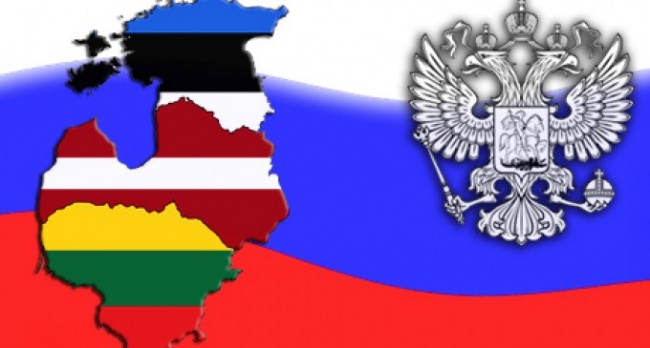 THE BALTIC COUNTRIES: 25 YEARS OF ACCOMPLISHMENT AND FEAR
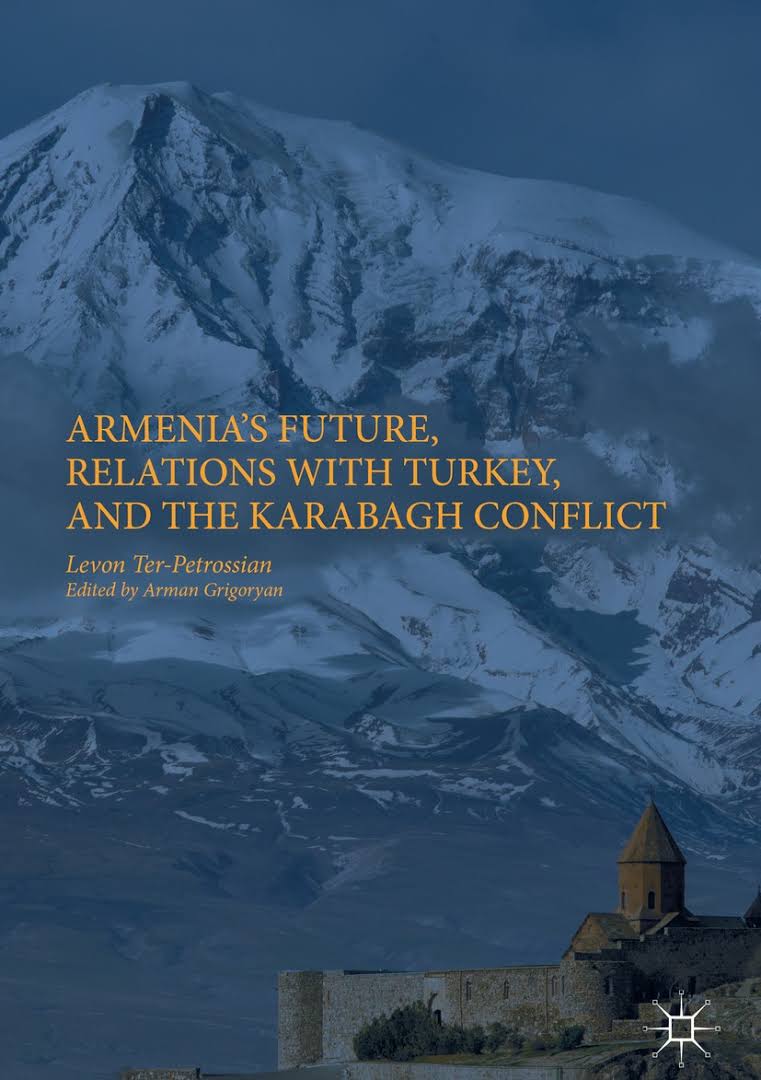 BOOK REVIEW: “ARMENIA’S FUTURE, RELATIONS WITH TURKEY, AND THE KARABAGH CONFLICT”
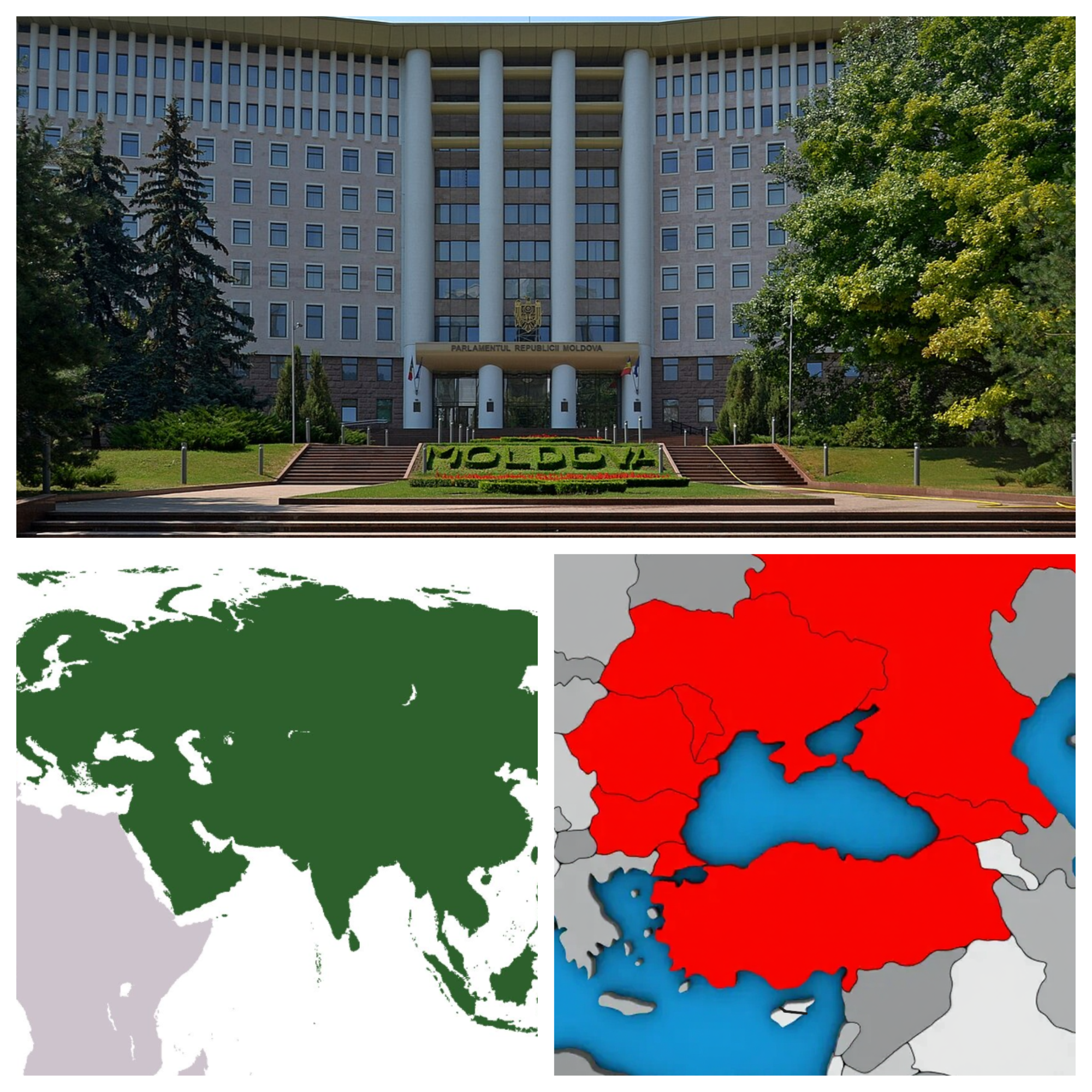 REFORMING MOLDOVA: STABILITY THROUGH CONSTRUCTIVE EURASIANISM