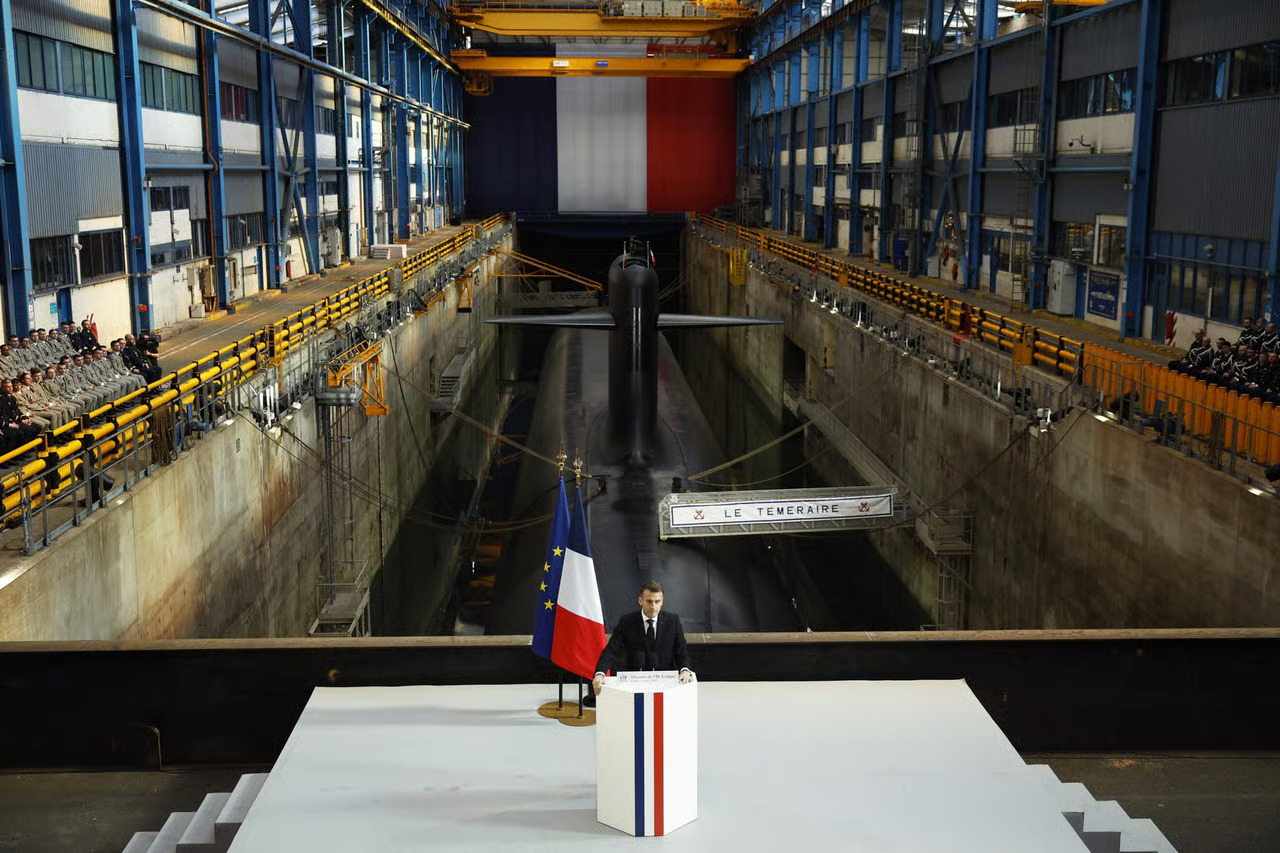
French President Emmanuel Macron, yesterday (March 2) in Brittany, in the northwest of France, in his speech at the Ile Longue strategic submarine base, where four French nuclear submarines are located, made "historic" statements regarding his country's nuclear weapons doctrine. Macron, as it will be remembered, addressed the issue of nuclear weapons in his speech at the 2026 Munich Security Conference, which was detailed in the AVİM analysis cited in the footnote below, and stated that "they need to redefine nuclear deterrence, and that they have started a strategic dialogue that will be detailed in a few weeks."[1]
Macron, in his speech at Île Longue,[2] in brief summary, pointed out that Russia's war against Ukraine, China's growing military power, and the changing U.S. defense priorities require more nuclear warheads, and that France should adopt "forward deterrence" as it faces a more threatening world. In this context, referring to the fleet of nuclear-capable Rafale warplanes, he noted that elements of the strategic air force can be temporarily deployed to allied countries depending on the situation, but any other country will not participate in decision-making with regarding the use of nuclear weapons. The French President mentioned in name Germany, Poland, Greece, the Netherlands, Belgium, Denmark, and Sweden in the context of temporary deployments.[3] He emphasized the possibility of enhanced cooperation and joint nuclear exercises with these countries. Macron also underlined that France has no intention to replace American nuclear weapons and NATO as the final guarantor of the continent's security, and that these efforts are complementary to NATO's nuclear mission. The main theme of Macron's speech was formulated as." Whoever wants to be free must be feared. Whoever wants to be feared must be strong."
On the other hand, parallel to Macron's speech, Germany and France simultaneously published joint statements of Macron and German Chancellor Merz on nuclear cooperation.[4] In the joint statement, it is stated that in the spirit of their close partnership as set out in Article 4 of the Treaty of Aachen, France and Germany have decided to enter into closer cooperation in the field of deterrence in response to the evolving threat landscape, that France and Germany have established a high-ranking nuclear steering group that will act as a bilateral framework for doctrinal dialogue and the coordination of strategic cooperation, including consultations regarding the appropriate mix of conventional, missile defence and French nuclear capabilities and that France and Germany have agreed to take first concrete steps beginning this year, including German conventional participation in French nuclear exercises and joint visits to strategic sites as well as development of conventional capabilities with European partners. It is further noted that France and Germany will also increase their ability, as Europeans, to manage escalation beneath the nuclear threshold – in particular in the fields of Early Warning and Air Defense and Deep Precision Strike. As per US and NATO nucleer capabilities the joint statement underlined that Franco-German cooperation is based on the shared understanding that the nuclear dimension of deterrence remains a cornerstone of European security, relying on US extended deterrence, including US nuclear weapons forward-deployed to Europe, and on the independent strategic nuclear forces of France and the United Kingdom, which have a deterrent role of their own and contribute significantly to the overall security of the Alliance. Additonally it is underlined that Franco-German cooperation will add to, not substitute for, NATO’s nuclear deterrence and NATO’s nuclear sharing arrangements, to which Germany contributes and will continue to contribute, and that two countries will continue to comply with their obligations under international law including the Treaty on the Non-Proliferation of Nuclear Weapons. The following points are highlighted in the last paragraph of the statement:
“In light of their strong commitment to Article 5 of the North Atlantic Treaty and Art. 42 (7) of the Treaty on European Union, Franco-German cooperation aims at strengthening the systems of collective security both countries belong to. It aims at enhancing Europe’s security as a whole. Special attention will be given to coordination with the United States, the United Kingdom, other Allies and NATO.”
Final Remarks
In our AVİM analyses presented before and after the 2026 Munich Security Conference, we stated that the rights and rules-based international order was left its seat to a new global disorder. In this context, we reiterated the importance of strengthening Türkiye's "strategic autonomy," a point we have long emphasized. Recent developments in our region and the efforts, led by France and joined by Germany and the UK, to develop a unique, next-generation nuclear deterrence across Europe, independent of NATO's nuclear deterrence along with possible nuclear weapons deployments just next to Türkiye , make the need to expand and maintain Türkiye's "strategic autonomy" an increasingly vital priority.
*Picture: Politico
© 2009-2025 Center for Eurasian Studies (AVİM) All Rights Reserved















 A BRIEF ANALYSIS OF THE PRESENT-DAY IMPLICATIONS OF THE COLLAPSE OF ARMENIAN GENOCIDE CLAIMS WITHIN THE FRAME OF THE RULES-BASED INTERNATIONAL ORDER
 BEYOND DOUBLE STANDARDS IN THE BALKANS: REBUILDING TRUST IN OSCE ELECTION MONITORING
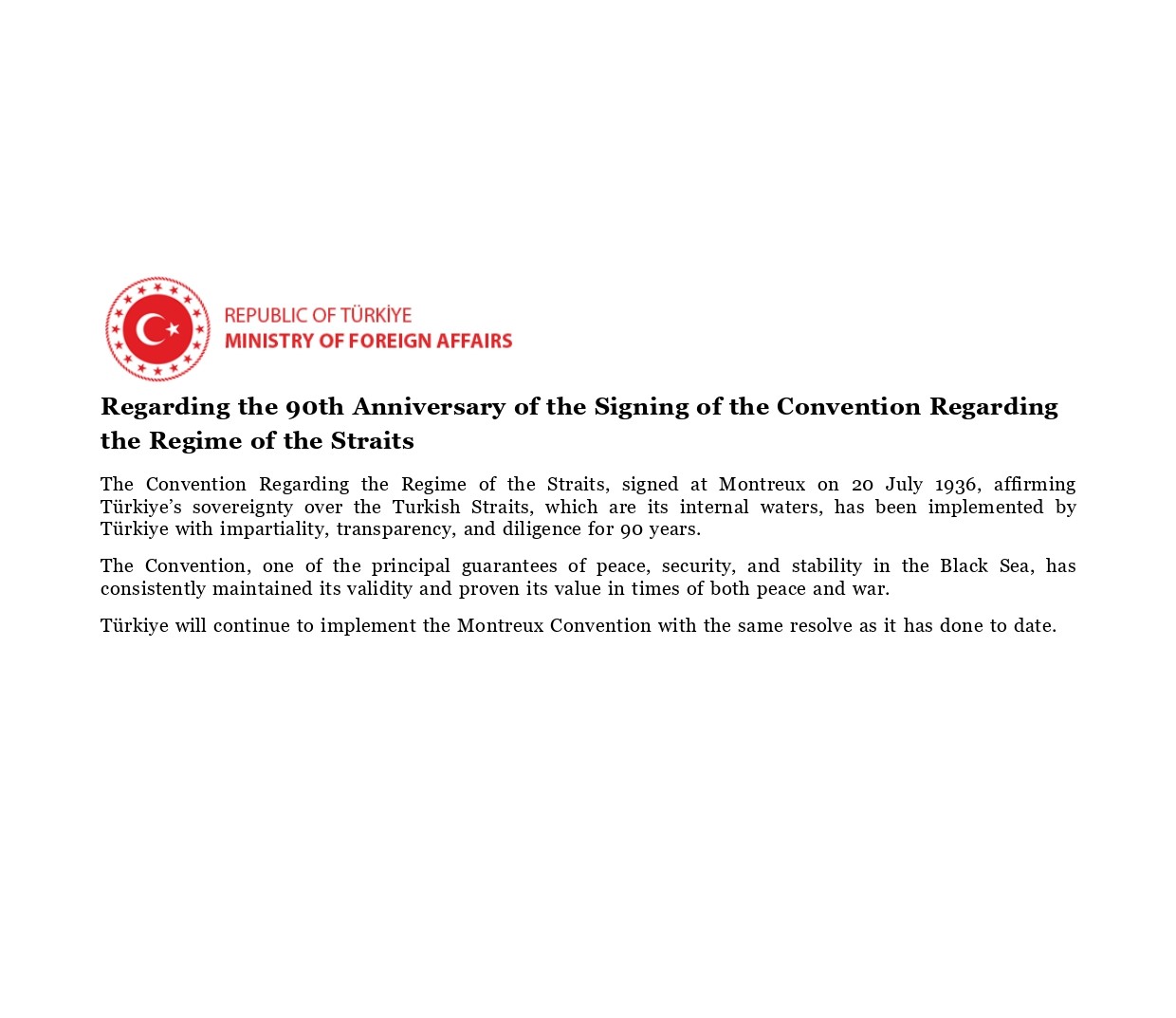 MONTREUX, CONSTRUCTIVE EURASIANISM, AND BLACK SEA STABILITY: REASSESSING TÜRKİYE’S STRAITS REGIME ON ITS 90TH ANNIVERSARY
 JOE BIDEN’S STATEMENT ON 1915 EVENTS: PURPOSEFUL POLITICAL ACTIONS MAY CAUSE UNANTICIPATED CONSEQUENCES, AN ANALYSIS FROM THE SOCIOLOGICAL VIEWPOINT
 POPE FRANCIS IN AZERBAIJAN
 BLACK STAIN ON COUNTER TERRORISM: HAMPIG SASUNYAN CASE
 ISSUES OF INTEREST BEFORE THE SHANGHAI COOPERATION ORGANIZATION SUMMIT IN SAMARKAND
 VICTIMIZED TURKS IN SWITZERLAND
 THE INAUGURATION SPEECH OF THE NEWLY ELECTED ARMENIAN PRESIDENT ARMEN SARKISSIAN: MORE OF THE SAME IDEOLOGICAL OUTLOOK