This is the English translation of a Turkish language article that was originally published by AVİM on 5 November 2025.
Tensions between the Armenian government and the Armenian Apostolic Church reached a new peak in mid-October with the arrest of several priests. During this period, the gesture of “extending a hand for dialogue” from Aram I -the spiritual leader of the Armenian Catholicosate of Cilicia located in Antelias/Lebanon- to Prime Minister Nikol Pashinyan, and the sharp condemnation of this move by the Armenian Revolutionary Federation (ARF - Dashnak Party), revealed internal fractures within the Church as well as the depth of political polarization. These events can be seen as a contemporary reflection of Armenia’s historical struggle between efforts toward secularization and the power of traditional religious institutions.
On 14-15 October 2025, six high-ranking clergymen, including the Bishop of the Diocese of Aragatsotn Mkrtich Proshyan, were detained. The official justification was their call for participation in opposition rallies during the 2021 elections. Circles affiliated with the Armenian Catholicos of Etchmiadzin Karekin II (also referred to as the “Catholicos of All Armenians”), described the arrests as “politically motivated persecution,” and in a statement released on 16 October declared that “full responsibility lies with Prime Minister Pashinyan.” That same day, Archbishop Shahan Sarkissian of the Catholicosate of Cilicia conveyed to Pashinyan a commemorative book marking the 30th anniversary of Aram I’s enthronement, along with the Catholicos’s “blessings and greetings.”[1] Later that evening, however, the said catholicosate publicly announced its condemnation of the arrests.
The ARF, on the other hand, issued a statement evaluating Aram I’s contact with Pashinyan. In the statement released on 17 October, the party accused Pashinyan of a “coordinated attack on the Armenian Church” and stated that Aram I’s gesture was “unacceptable.” The statement also asserted that “These attacks on the Church by the authorities pose a threat to national identity” and called for the two Catholicosates (Etchmiadzin and Cilicia) to act together for a “joint defense.” While the ARF interpreted Aram I's contact with Pashinyan as an “attempt to create a rift within the church,” this development has had a broad repercussion among the Diaspora public. Traditionally positioned along a church-nationalism axis, the ARF has openly expressed that it regards Pashinyan’s reform initiatives as “anti-national.”
The relationship between the Armenian Apostolic Church and the state dates back to the power struggle between King Tiridates III, who declared Christianity the official religion in 301, and Saint Gregory the Illuminator. Throughout the centuries of administration under the Sasanians, Byzantines, Arabs, Seljuks, Ottomans, and Russians, the Church has functioned as a “state within a state” that preserved Armenian communal unity. Steps such as the establishment of the Armenian Patriarchate of İstanbul (Constantinople) in 1461 during the Ottoman period and transfer of Caucasian Albanian church properties in 1836 under the Tsarist Russia, further consolidated the Armenian Apostolic Church’s political influence. After Armenia gained independence in 1991, the Church maintained its privileged status as the “national church” within the constitution. The Pashinyan administration, however, is seeking to limit the power of this structure.[2]
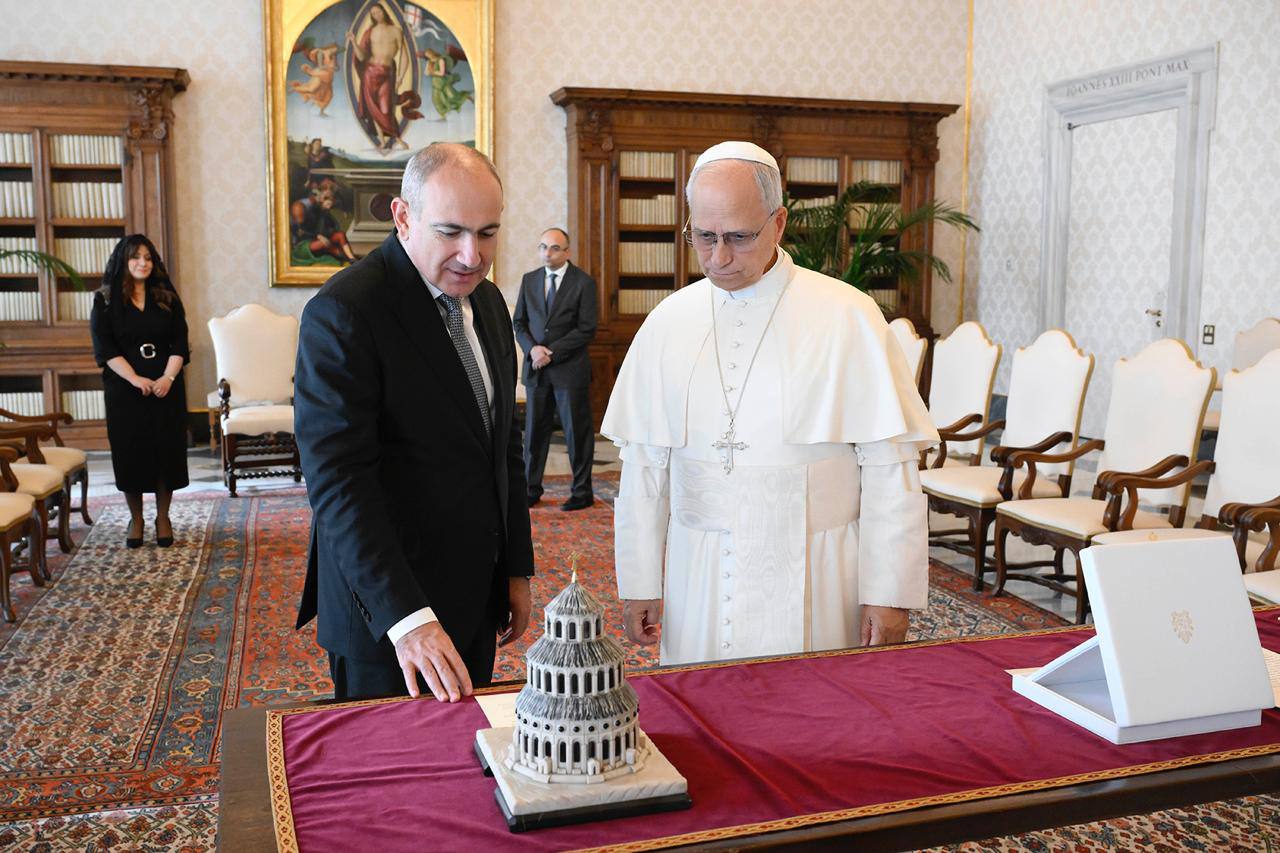
Although Pashinyan reiterates that he respects the Church as an institution, he has called for the resignation of Karekin II, pointing to the Catholicos’s “personal record.” This approach targets the internal hierarchy of the Church while claiming to preserve the institution itself. In this respect, Pashinyan’s visit to the Vatican during the same week (20 October) can be interpreted as a strategic move. In his meeting with Pope Leo XIV, the canonization of Maloyan, the role of the Mekhitarist clergy, and the need for “lasting peace” in the South Caucasus were emphasized. The official statements highlighted the “traditional closeness” of Armenia-Vatican relations. While criticizing the Church leadership domestically, Pashinyan has strengthened his image as a “messenger of peace” within the international Christian community.
Armenia’s internal political crisis is critical for regional stability. Pashinyan’s efforts toward normalization with Türkiye and Azerbaijan -border delimitation, communication channels, and diplomatic contacts- have been met with the Church-centered opposition’s accusations of “betrayal”. However, while the government defends the peace process on the grounds of “economic development and sustainable security” of Armenia, from Türkiye’s perspective, Pashinyan’s secularization and normalization-focused administration offers a constructive basis for regional cooperation. While a deepening church-state confrontation may increase domestic polarization in the short term, it could enhance Armenia’s capacity to act as a rational foreign policy actor in the longer term. In this regard, Türkiye’s support for the normalization process contributes to regional stability and opens a window of opportunity for building mutual trust.
Aram I’s outreach to Pashinyan has produced fractures rather than unity within the Armenian Apostolic Church. The ARF’s reaction demonstrates the diaspora-nationalist wing’s loyalty to Etchmiadzin, while Cilicia (Antelias)’s dual position of “condemnation + dialogue” reflects a search for strategic balance. As will be recalled, Pashinyan’s stated support for regional peace has long been unsettling for the ARF. In its recent statement, the ARF has targeted Pashinyan not directly but indirectly through Aram I, and by pointing to the rift within the global Christian community, it has argued that Pashinyan is disrupting not only regional politics but also the global religious order. By contrast, Pashinyan has strengthened his international legitimacy through his peace messages in the Vatican. Despite his difficulties in managing Armenia’s domestic political crisis, being received by the Pope has been a significant development. As Pashinyan continues his struggle for regional peace, the “church-state” tension in Armenia’s internal politics stands out as another front from which he hopes to emerge victorious.
*Picture: https://www.agos.com.tr/tr/yazi/36067/papa-14-leo-ve-ermenistan-basbakani-pasinyan-gorustu
© 2009-2025 Center for Eurasian Studies (AVİM) All Rights Reserved
















 "WATER DIVINER"
 ASALA BUZZING ON THE ROAD TO NORMALIZATION BETWEEN TÜRKİYE AND ARMENIA
 TURKEY IS ALWAYS ON SARKISYAN'S AGENDA
 STATE CEREMONY HELD FOR STRUMA VICTIMS
 WHAT IS HAPPENING IN KYRGYZSTAN?
 AVİM ON THE ROAD TO THE FIFTEENTH ANNIVERSARY OF ITS FOUNDING