














This is the English translation of a Turkish language article that was originally published by AVİM on 20 July 2026.
For decades, the Cyprus question has primarily been debated through the lenses of security, sovereignty, international law, and diplomatic recognition. In recent years, however, a new dimension has become apparent. The parties are no longer seeking to strengthen their strategic positions solely through political discourse or diplomatic initiatives; infrastructure projects that will shape the island’s future have also emerged as an important instrument of policy. This development suggests that the Cyprus question is gradually evolving into a case of infrastructure geopolitics, where physical connectivity is becoming as significant as political negotiations.
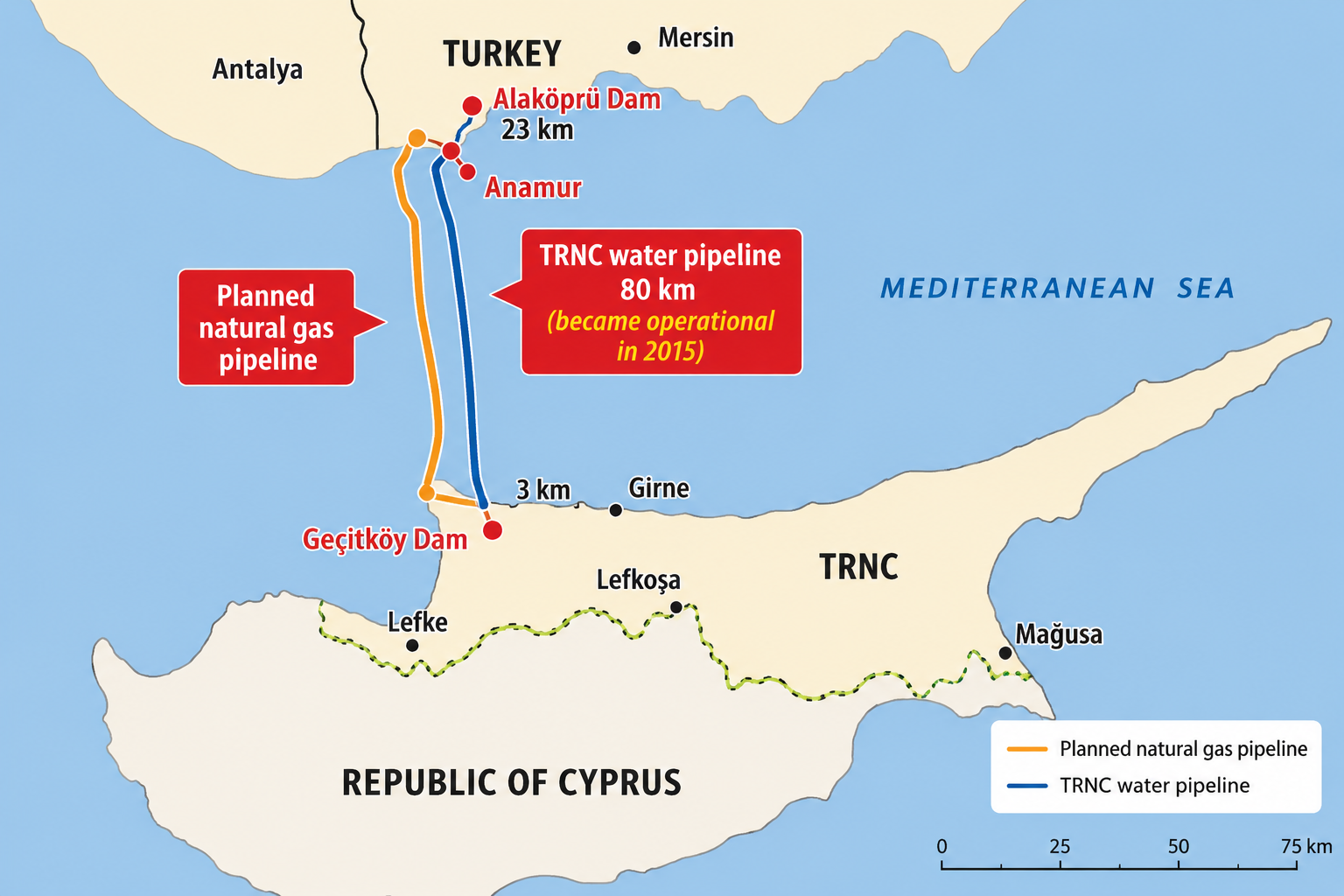
The memorandum of understanding signed between Türkiye and the Turkish Republic of Northern Cyprus (TRNC) on 10 July 2026 for the construction of a natural gas pipeline represents the latest example of this broader trend.[1] At first sight, the project may appear to be a technical investment aimed at enhancing energy supply security. However, when examined in light of its timing, design, and role within the broader framework of regional energy politics, it becomes evident that the initiative carries strategic implications extending well beyond the energy sector. Rather than constituting an isolated project, it reflects a broader policy pursued by Türkiye over the past decade, one that seeks to deepen integration with the TRNC through a series of mutually reinforcing infrastructure initiatives.
The first major milestone of this process was the Türkiye-TRNC Water Supply Project, completed in 2015. Widely known as the “Project of the Century”, the initiative was designed to meet the island’s freshwater needs while simultaneously becoming one of the most tangible examples of infrastructure-based cooperation between Türkiye and TRNC. It was followed by the electricity interconnection project which aims to strengthen TRNC’s energy supply security by linking it to Türkiye’s electricity grid. The recently announced natural gas pipeline should therefore be viewed not as a standalone undertaking but as the latest component of this long-term strategy of infrastructural integration. Taken together, these projects represent a coherent and complementary vision rather than a series of unrelated investments. Whereas the security dimension of the Cyprus question was largely shaped in the aftermath of 1974, infrastructure projects have emerged as a defining element of Türkiye-TRNC relations and of the island’s broader geopolitical landscape.
One of the most significant features distinguishing the natural gas pipeline from previous projects is that it is not intended solely to meet the TRNC’s domestic energy needs. Turkish officials have stated that the pipeline will be designed to operate in a “bidirectional” manner.[2] Such a design reflects a longer-term strategic vision that extends beyond present-day consumption requirements. In the future, it could enable natural gas produced in the Eastern Mediterranean to be transported to Türkiye and subsequently to European markets, thereby creating an alternative regional energy corridor.
To date, no commercially viable natural gas reserves have been confirmed within the maritime jurisdiction claimed by TRNC. Nevertheless, the decision to design the pipeline as a bidirectional system indicates that the project is not intended merely to address today’s energy needs. Viewed in the context of Türkiye’s broader ambition to establish itself as a regional energy hub, it is evident that TRNC is also being positioned as part of this long-term strategic vision. Consequently, the project goes beyond enhancing the island’s energy security, it also represents a strategic investment aimed at shaping the future geopolitical landscape of energy in the Eastern Mediterranean.
The political developments preceding the announcement of the project are equally noteworthy. In July 2026, the European (Union) Parliament (EP) adopted a resolution containing serious allegations and defamatory claims against the Turkish Armed Forces in relation to the events of 1974.[3] Ankara rejected the resolution, describing it as a politically motivated document that disregards historical realities and declaring it “null and void”.[4] Although preparations for the resolution had begun before the signing of the natural gas memorandum, the close timing of these two developments suggests that the Cyprus question has entered a period in which the parties are increasingly seeking to reinforce their respective positions through different strategic instruments.
The EP resolution was not the only noteworthy development. Following the signing of the natural gas memorandum between Türkiye and TRNC, the Ministry of Foreign Affairs of the Greek Cypriot Administration of Southern Cyprus (GCASC) described the agreement as “illegal”, arguing that it would further integrate what it referred to as the “occupied areas” with Türkiye.[5] Likewise, the European Union’s (EU) High Representative for Foreign Affairs and Security Policy, Kaja Kallas, stated that the EU expects Türkiye to respect the sovereignty and sovereign rights of the "Republic of Cyprus" (meaning GCASC), thereby framing the pipeline project primarily within the context of the sovereignty of an EU member state rather than its potential contribution to regional energy security.[6] These reactions demonstrate that the objections raised by both the Greek Cypriot side and the EU extend beyond the construction of a new energy project. At the core of their concerns lies the prospect of deeper infrastructural connectivity between Türkiye and TRNC. In other words, the debate is not only about the transportation of natural gas, it is about an emerging model of political and economic integration built upon infrastructure. This reflects a broader trend in contemporary international relations, where infrastructure has become an increasingly influential geopolitical instrument. Major powers and regional actors are no longer expanding their influence solely through military deployments or diplomatic initiatives, but also through ports, railways, energy pipelines, electricity grids, digital networks, and transportation corridors. China’s Belt and Road Initiative (BRI), the India-Middle East-Europe Economic Corridor (IMEC), and the EU's Global Gateway are examples of this global shift. Türkiye’s water, electricity, and natural gas projects with TRNC can likewise be understood as components of an infrastructure diplomacy strategy that strengthens physical connectivity and economic integration between the two sides.
Two distinct strategic approaches are becoming evident in the Cyprus question. On the one hand, Türkiye seeks to enhance the resilience of TRNC and deepen its de facto integration through infrastructure projects and stronger economic connectivity. On the other hand, the EU and GCASC continue to reinforce their political narratives through international legal arguments, human rights discourse, and diplomatic platforms, frequently overlooking the broader historical context and relying on one-sided interpretations of the Cyprus question. The use of such narratives as instruments of political pressure in international forums does not contribute to a constructive resolution of the Cyprus question. Instead, it represents yet another manifestation of the long-standing unilateral approach maintained by GCASC.
In the coming period, the completion of the natural gas pipeline and the implementation of the electricity interconnection project are expected to significantly strengthen the energy infrastructure of the Eastern Mediterranean while enhancing the region’s energy connectivity with Europe. In particular, the bidirectional design of the natural gas pipeline creates the potential for future energy resources discovered in the Eastern Mediterranean to reach European markets through Türkiye. From this perspective, the project represents a strategic asset whose significance extends well beyond Türkiye and TRNC, carrying important implications for the future of the Eastern Mediterranean’s energy architecture as well as for Europe’s efforts to diversify its energy supply and enhance its energy security.
Today, the developments in the island of Cyprus are not limited to the implementation of a new energy project. The infrastructure initiatives undertaken jointly by Türkiye and TRNC reinforce the existing partnership between the two sides while simultaneously promoting regional integration and strengthening energy connectivity in the Eastern Mediterranean. Attempts to politicize such constructive initiatives, rather than engaging with their potential contribution to regional stability and cooperation, once again demonstrate which actors continue to hinder the prospects for a more constructive approach to the Cyprus question.
[1] "Türkiye–TRNC Pipeline Project Could Expand Gas Export Options Beyond Northern Cyprus," AA Energy Terminal, July 14, 2026, https://www.aa.com.tr/en/energy/energy-diplomacy/turkiye-trnc-pipeline-project-could-expand-gas-export-options-beyond-northern-cyprus/58359
[2] Ministry of Energy and Natural Resources of the Republic of Türkiye, "Türkiye and TRNC Sign Memorandum of Understanding on Cooperation in the Field of Natural Gas," July 10, 2026, https://enerji.gov.tr/news-detail?id=31870
[3] European Parliament, Procedure 2026/2617(RSP): The Impact of the 1974 Turkish Invasion on Cypriot Women and Girls, and the Crimes Committed by Turkish Forces and Consequences on Gender Equality, Legislative Observatory (OEIL), https://oeil.europarl.europa.eu/oeil/en/procedure-file?reference=2026/2617(RSP)
[4] Ministry of Foreign Affairs of the Republic of Türkiye, "No: 129, 9 July 2026, Regarding the Resolution on Cyprus Adopted by the European Parliament," July 9, 2026, https://www.mfa.gov.tr/no_-129_-avrupa-parlamentosu-nda-kibris-konusunda-kabul-edilen-karar-hk.en.mfa
[5] Ministry of Foreign Affairs of the Republic of Cyprus, "Statement by the Ministry of Foreign Affairs of the Republic of Cyprus Regarding the Illegal 'Memorandum of Understanding' for the Development of a Natural Gas Pipeline", July 10, 2026, https://www.gov.cy/en/foreign-policy/statement-by-the-ministry-of-foreign-affairs-of-the-republic-of-cyprus-regarding-the-illegal-memorandum-of-understanding-for-the-development-of-a-natural-gas-pipeli/
[6] "EU's Kallas Tells Turkey to Respect Cyprus' Sovereignty over Gas Pipeline," Cyprus Mail , July 13, 2026, https://cyprus-mail.com/2026/07/13/eus-kallas-tells-turkey-to-respect-cyprus-sovereignty-over-gas-pipeline
© 2009-2025 Center for Eurasian Studies (AVİM) All Rights Reserved
No comments yet.
-
TÜRKİYE-TRNC STRATEGIC COOPERATION
Özge Emine ÖZÇELİK 27.07.2026 -
 INDIA’S STRATEGIC BALANCING CHALLENGES THE QUAD
Özge Emine ÖZÇELİK 21.01.2026 -
 SHANGHAI COOPERATION ORGANIZATION (SCO) BISHKEK SUMMIT
Özge Emine ÖZÇELİK 15.09.2026 -
 TÜRKİYE’S ROLE IN EUROPE’S CHANGING SECURITY STRATEGY
Özge Emine ÖZÇELİK 16.03.2026 -
 18TH BRICS NEW DELHI LEADERS’ SUMMIT
Özge Emine ÖZÇELİK 29.09.2026
-
 OPPOSITION AGAINST THE TURKEY-ARMENIA NORMALIZATION PROCESS THROUGH THE USE OF CARTOONS
Mehmet Oğuzhan TULUN 13.05.2022 -
 AN ARCHBISHOP OF THE ARMENIAN APOSTOLIC CHURCH HAND IN HAND WITH A MURDERER - BEHIND THE SCENES OF THE PROTESTS IN YEREVAN
Hazel ÇAĞAN ELBİR 23.05.2024 -
 THE GENOCIDE VERDICT OF THE UN BACKED CAMBODIA COURT AND THE 1915 EVENTS
Mehmet Oğuzhan TULUN 30.11.2018 -
 GENOCIDE ACCUSATION AS A FORM OF PUNISHMENT - II
Mehmet Oğuzhan TULUN 04.11.2019 -
 MOVIE WARS: THE TALE OF TWO NARRATIVES
Sean Patrick SMYTH 23.06.2017
-
25.01.2016
THE ARMENIAN QUESTION - BASIC KNOWLEDGE AND DOCUMENTATION -
12.06.2024
THE TRUTH WILL OUT -
27.03.2023
RADİKAL ERMENİ UNSURLARCA GERÇEKLEŞTİRİLEN MEZALİMLER VE VANDALİZM -
17.03.2023
PATRIOTISM PERVERTED -
23.02.2023
MEN ARE LIKE THAT -
03.02.2023
BAKÜ-TİFLİS-CEYHAN BORU HATTININ YAŞANAN TARİHİ -
16.12.2022
INTERNATIONAL SCHOLARS ON THE EVENTS OF 1915 -
07.12.2022
FAKE PHOTOS AND THE ARMENIAN PROPAGANDA -
07.12.2022
ERMENİ PROPAGANDASI VE SAHTE RESİMLER -
01.01.2022
A Letter From Japan - Strategically Mum: The Silence of the Armenians -
01.01.2022
Japonya'dan Bir Mektup - Stratejik Suskunluk: Ermenilerin Sessizliği -
03.06.2020
Anastas Mikoyan: Confessions of an Armenian Bolshevik -
08.04.2020
Sovyet Sonrası Ukrayna’da Devlet, Toplum ve Siyaset - Değişen Dinamikler, Dönüşen Kimlikler -
12.06.2018
Ermeni Sorunuyla İlgili İngiliz Belgeleri (1912-1923) - British Documents on Armenian Question (1912-1923) -
02.12.2016
Turkish-Russian Academics: A Historical Study on the Caucasus -
01.07.2016
Gürcistan'daki Müslüman Topluluklar: Azınlık Hakları, Kimlik, Siyaset -
10.03.2016
Armenian Diaspora: Diaspora, State and the Imagination of the Republic of Armenia -
24.01.2016
ERMENİ SORUNU - TEMEL BİLGİ VE BELGELER (2. BASKI)



-
AVİM Conference Hall 24.01.2023
CONFERENCE TITLED “HUNGARY’S PERSPECTIVES ON THE TURKIC WORLD"