














Introduction
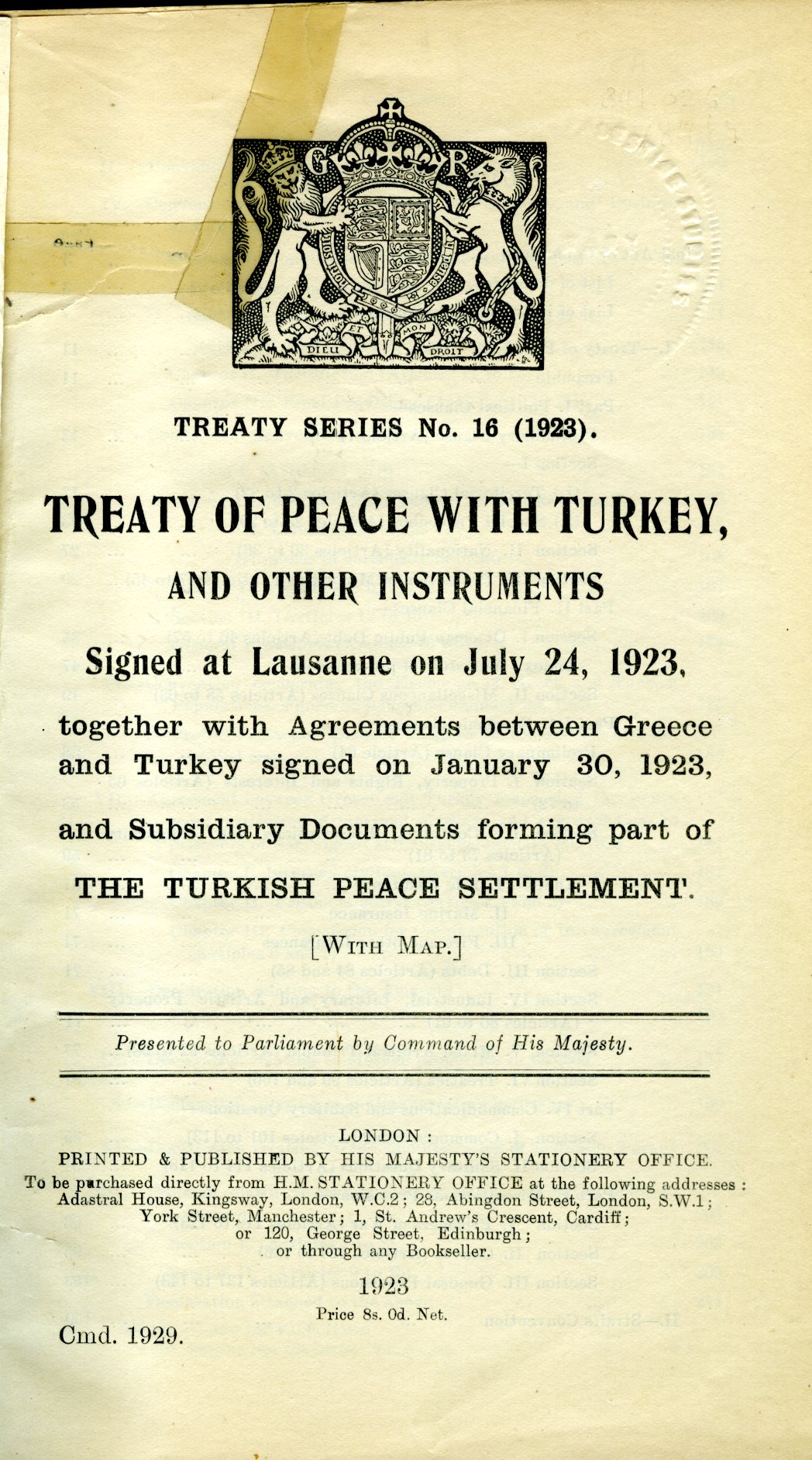
The 103rd anniversary of the Lausanne Peace Treaty offers an appropriate moment for legal and political reflection, rather than for ceremonial commemoration alone. In AVİM’s analytical framework, Lausanne should be approached as a living component of the treaty-based order that continues to shape regional stability, minority rights, and interstate relations, particularly when selective interpretations of international commitments reappear in the Balkans and the eastern Mediterranean.
Against this background, the present commentary examines how the treaty’s enduring significance is being tested by developments in Western Thrace and by related debates in Istanbul. The discussion follows a clear line of reasoning: if Lausanne remains a foundational legal reference, then state practice in relation to elected muftis, minority education, and institutional claims such as the Ecumenical title should be assessed not as isolated controversies but as questions of treaty fidelity and legal consistency.
Lausanne and Treaty Integrity
The Lausanne Peace Treaty remains a cornerstone of the legal architecture of the Republic of Türkiye and a stabilizing factor in the broader Balkan environment. In AVİM’s perspective, this treaty should be understood not as a matter of ceremonial commemoration, but as part of a wider treaty-based order that helps protect regional stability against unilateral revisionism and legal selectivity. In this respect, Montreux offers a useful historical parallel, since it continues to demonstrate how a well-established international agreement can help preserve order and predictability in an otherwise unstable geopolitical setting.[1]
Western Thrace and Treaty Obligations
Against this legal background, the commentary can now turn to the central issue: Greece’s treatment of the Turkish Muslim minority in Western Thrace. The refusal to recognize elected muftis, together with the continued reliance on state-appointed structures, may be presented as a challenge to the treaty order established by Lausanne, especially since the Turkish Foreign Ministry has explicitly stated that such practices disregard the rights and freedoms guaranteed under the treaty. This argument should be made calmly and explicitly: the concern is not a single administrative choice, but rather a pattern of state practice that departs from treaty-based obligations.[2]
A similar logic applies to minority education. Reports on the closure of Turkish minority schools in Western Thrace indicate that these measures are not merely technical or demographic adjustments; they may be viewed as part of a broader pattern affecting rights protected under Lausanne, particularly when similar closures are repeatedly framed as temporary or administrative while their cumulative effect reduces the institutional space of the minority. In AVİM’s earlier Lausanne-related analyses, this type of selective implementation is treated as a legal and political problem because it weakens the credibility of international commitments and normalizes unequal treatment.[3]
The debate over the Ecumenical title in Istanbul should not be detached from this treaty framework. It should be assessed in the same analytical register as the Western Thrace cases: namely, through the letter and spirit of Lausanne, and with attention to reciprocity, legal consistency, and regional stability. Türkiye’s approach is to preserve the treaty order as a matter of principle, whereas attempts to expand symbolic or institutional claims beyond that framework risk reintroducing the very selectivity that Lausanne was meant to prevent.
The Ecumenical Title and Lausanne
A European state cannot easily claim to uphold the principle of rule-based international conduct while selectively disregarding an international treaty to which it remains bound. In the case at hand, the issue is not only whether Greece formally cites Lausanne, but whether its treatment of the Turkish Muslim minority in Western Thrace is consistent with the treaty’s substantive guarantees and the responsibilities that flow from them. AVİM’s earlier Lausanne-related analyses frame this question as one of legal coherence rather than political preference, and this is why the commentary should avoid polemics while still making a clear normative judgment.
From that perspective, Türkiye’s position may be presented as legalist and stability-oriented: it insists on the preservation of treaty commitments because treaty fidelity reduces uncertainty and helps contain bilateral tensions before they spill over into the wider region. By contrast, practices that dilute or bypass the treaty framework create ambiguity inside Greece and weaken confidence in the regional legal order, especially when they concern minority rights that are already politically sensitive. The logic here is straightforward: if the treaty is treated as selectively binding, the predictability it is meant to provide is weakened accordingly.[4]
The same standard should inform the discussion of the Heybeliada issue and the broader Ecumenical title debate. Greece and the Greek Orthodox Church should, in this context, treat Türkiye’s approach to Lausanne as an example of restraint and legal consistency, because the durable protection of institutional rights depends on reading the treaty through both its letter and its spirit. This keeps the commentary firmly within AVİM’s style: sober, analytical, and explicitly committed to international-law-based stability rather than symbolic confrontation.[5]
Regional Stability and Legal Consistency
Lausanne remains relevant because it continues to help preserve a legal order in an otherwise unstable regional environment. The preceding analysis shows that this relevance is not abstract: it rests on the treaty’s practical capacity to constrain selective interpretations, sustain reciprocity, and provide a predictable legal framework for relations between Türkiye, Greece, and the wider Balkan region.
On that basis, the core conclusion is straightforward. When treaty obligations are applied selectively, the result is not only bilateral mistrust but also a broader erosion of confidence in international law itself. AVİM’s earlier Lausanne-related analyses underline precisely this point: the durability of a treaty depends on its consistent observance in both letter and spirit.
Its continued integrity remains essential for legal predictability, political restraint, and stable relations among neighboring states.
*Picture: Interactive Encyclopedia of the Palestine Question
[1] Teoman Ertuğrul Tulun. The Ninety-Seventh Anniversary Of The Signing Of The Peace Treaty Of Lausanne. AVİM, Commentary No: 2020/21. 21.07.2020.
doi: 10.6084/m9.figshare.22795670 , https://avim.org.tr/en/Yorum/THE-NINETY-SEVENTH-ANNIVERSARY-OF-THE-SIGNING-OF-THE-PEACE-TREATY-OF-LAUSANNE
[2] “Turkish Minority of Western Thrace and the Turkish Community in the Dodecanese,” Republic of Türkiye Ministry of Foreign Affairs, https://www.mfa.gov.tr/turkish-minority-of-western-thrace.en.mfa
[3] Teoman Ertuğrul Tulun. 19 May And Pontus Stories. AVİM, Commentary No: 2019/36. 20.05.2019. https://avim.org.tr/en/Pdf/Yorum/4318 ; “No: 66, 8 April 2026, Regarding Greece’s Policies Toward the Muftis of the Turkish Minority in Western Thrace,” Republic of Türkiye Ministry of Foreign Affairs, April 08, 2026, https://www.mfa.gov.tr/no_-66_-yunanistan-in-bati-trakya-turk-azinliginin-muftuluklerine-yonelik-uygulamalari-hk.en.mfa
[4] “No: 248, 4 August 2022, Press Release Regarding the Act on the Muftis in Western Thrace,” Republic of Türkiye Ministry of Foreign Affairs, August 04, 2022, https://www.mfa.gov.tr/no_-248_-yunanistan-in-bati-trakya-muftuluklerine-iliskin-hazirladigi-yasa-hk.en.mfa
[5] Teoman Ertuğrul Tulun. Remembering And Reminding The Significance, Meaning, And Provisions Of The Lausanne Peace Treaty In Its Centenary. AVİM, Commentary No: 2023/10. 11.05.2023.
doi: 10.6084/m9.figshare.23039990
© 2009-2025 Center for Eurasian Studies (AVİM) All Rights Reserved
No comments yet.
-
 FRANCE, TÜRKİYE, AND THE BLACK SEA ORDER: LEGAL REALITIES VERSUS STRATEGIC SHORTCUTTING
Teoman Ertuğrul TULUN 04.02.2026 -
 EURASIAN DEMOGRAPHY’S TURNING POINT: WHY TURKIC STATES MUST LEAD ON ELDERLY RIGHTS
Teoman Ertuğrul TULUN 21.11.2025 -
 TÜRKİYE-SERBIA RAPPROCHEMENT AND THE BALKAN PEACE PLATFORM: TESTING BALANCING ROLE
Teoman Ertuğrul TULUN 24.02.2026 -
 EU’S NEW CENTRAL ASIA STRATEGY AND NOTION OF CONSTRUCTIVE EURASIANISM
Teoman Ertuğrul TULUN 16.07.2019 -
 VISIT OF SWEDISH MEMBER OF THE EUROPEAN PARLIAMENT TO KARABAKH: FORGOTTEN MISERY OF AZERBAIJANIS
Teoman Ertuğrul TULUN 15.02.2018
-
 TENSIONS SURGE IN SOUTH CHINA SEA AS CHINA LOCKS HORNS WITH PHILIPPINES, VIETNAM
Hande Apakan 06.05.2014 -
 EUROPEAN CURE=ARMENIAN AFFLICTION: PRONOUNCING HATE SPEECH UNDER THE GUISE OF NATIONALISM
Teoman Ertuğrul TULUN 09.10.2018 -
 CELEBRATING 15 YEARS OF AVİM - A JOURNEY OF EXCELLENCE AND ASPIRATION
AVİM 11.01.2024 -
PRESIDENT SARKISIAN VISITING NICOSIA AND ATHENS
Ömer Engin LÜTEM 20.01.2011 -
IS IT REALLY A SUCCESS?
Ömer Engin LÜTEM 05.03.2010
-
25.01.2016
THE ARMENIAN QUESTION - BASIC KNOWLEDGE AND DOCUMENTATION -
12.06.2024
THE TRUTH WILL OUT -
27.03.2023
RADİKAL ERMENİ UNSURLARCA GERÇEKLEŞTİRİLEN MEZALİMLER VE VANDALİZM -
17.03.2023
PATRIOTISM PERVERTED -
23.02.2023
MEN ARE LIKE THAT -
03.02.2023
BAKÜ-TİFLİS-CEYHAN BORU HATTININ YAŞANAN TARİHİ -
16.12.2022
INTERNATIONAL SCHOLARS ON THE EVENTS OF 1915 -
07.12.2022
FAKE PHOTOS AND THE ARMENIAN PROPAGANDA -
07.12.2022
ERMENİ PROPAGANDASI VE SAHTE RESİMLER -
01.01.2022
A Letter From Japan - Strategically Mum: The Silence of the Armenians -
01.01.2022
Japonya'dan Bir Mektup - Stratejik Suskunluk: Ermenilerin Sessizliği -
03.06.2020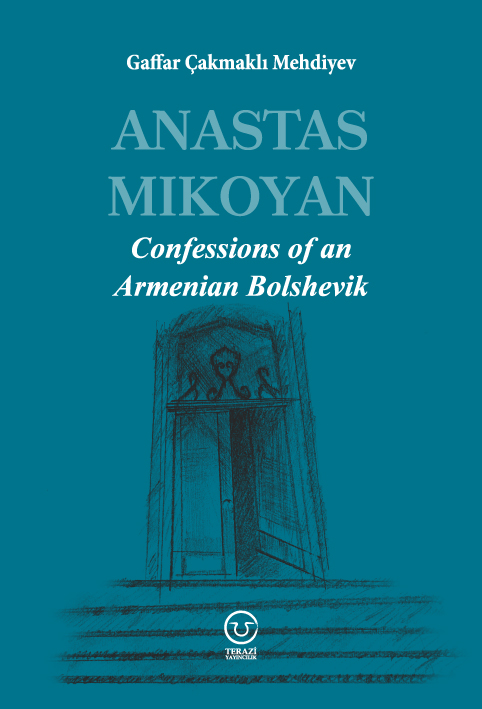
Anastas Mikoyan: Confessions of an Armenian Bolshevik -
08.04.2020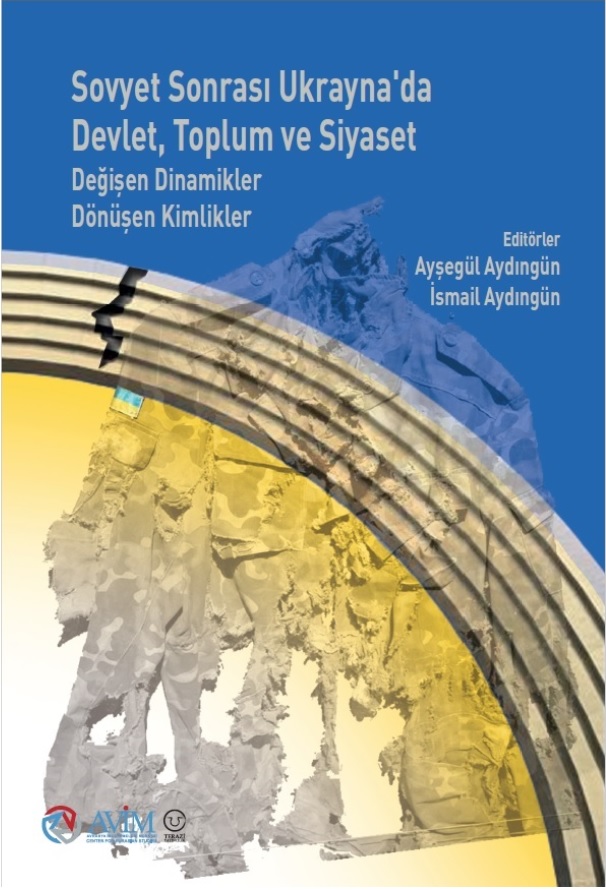
Sovyet Sonrası Ukrayna’da Devlet, Toplum ve Siyaset - Değişen Dinamikler, Dönüşen Kimlikler -
12.06.2018
Ermeni Sorunuyla İlgili İngiliz Belgeleri (1912-1923) - British Documents on Armenian Question (1912-1923) -
02.12.2016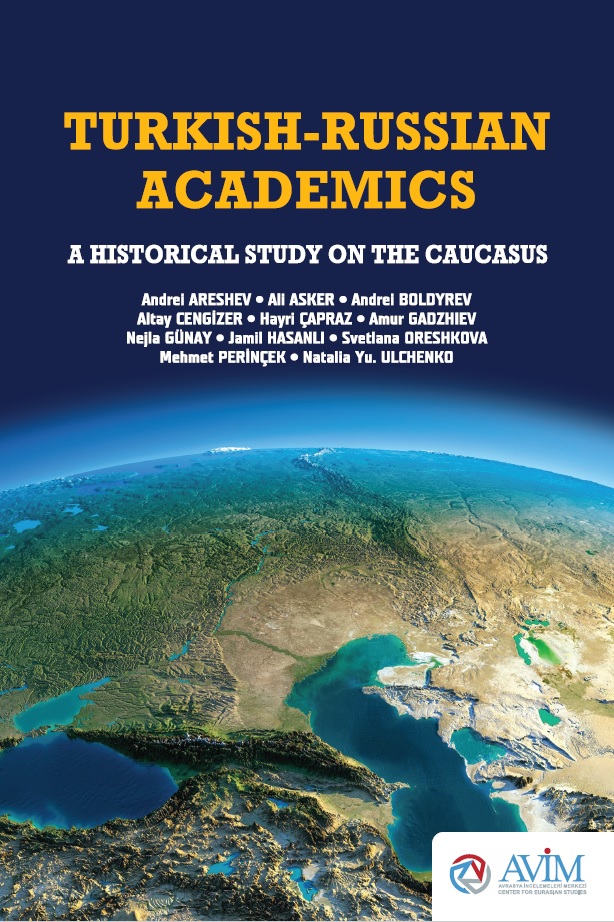
Turkish-Russian Academics: A Historical Study on the Caucasus -
01.07.2016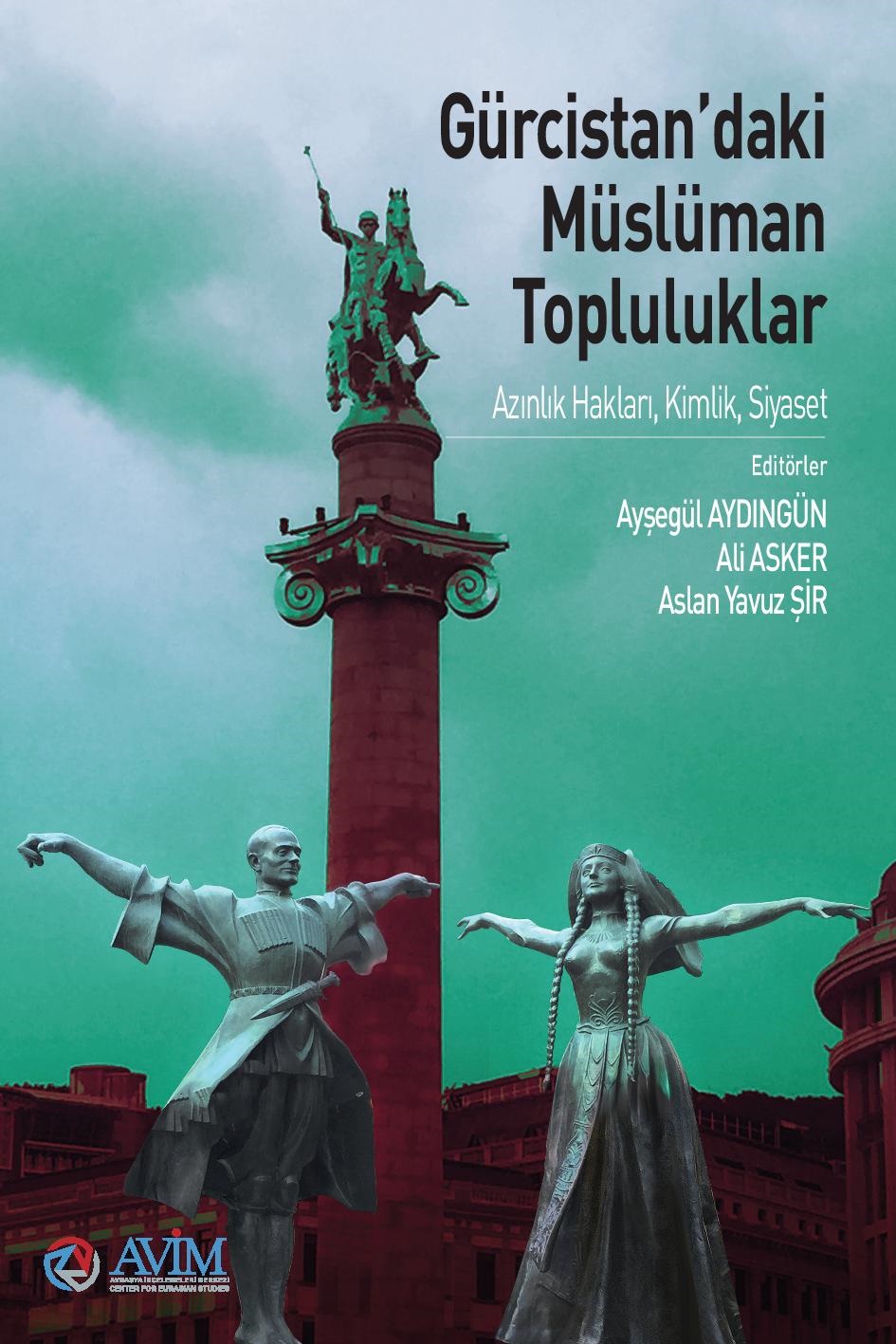
Gürcistan'daki Müslüman Topluluklar: Azınlık Hakları, Kimlik, Siyaset -
10.03.2016
Armenian Diaspora: Diaspora, State and the Imagination of the Republic of Armenia -
24.01.2016
ERMENİ SORUNU - TEMEL BİLGİ VE BELGELER (2. BASKI)
-
AVİM Conference Hall 24.01.2023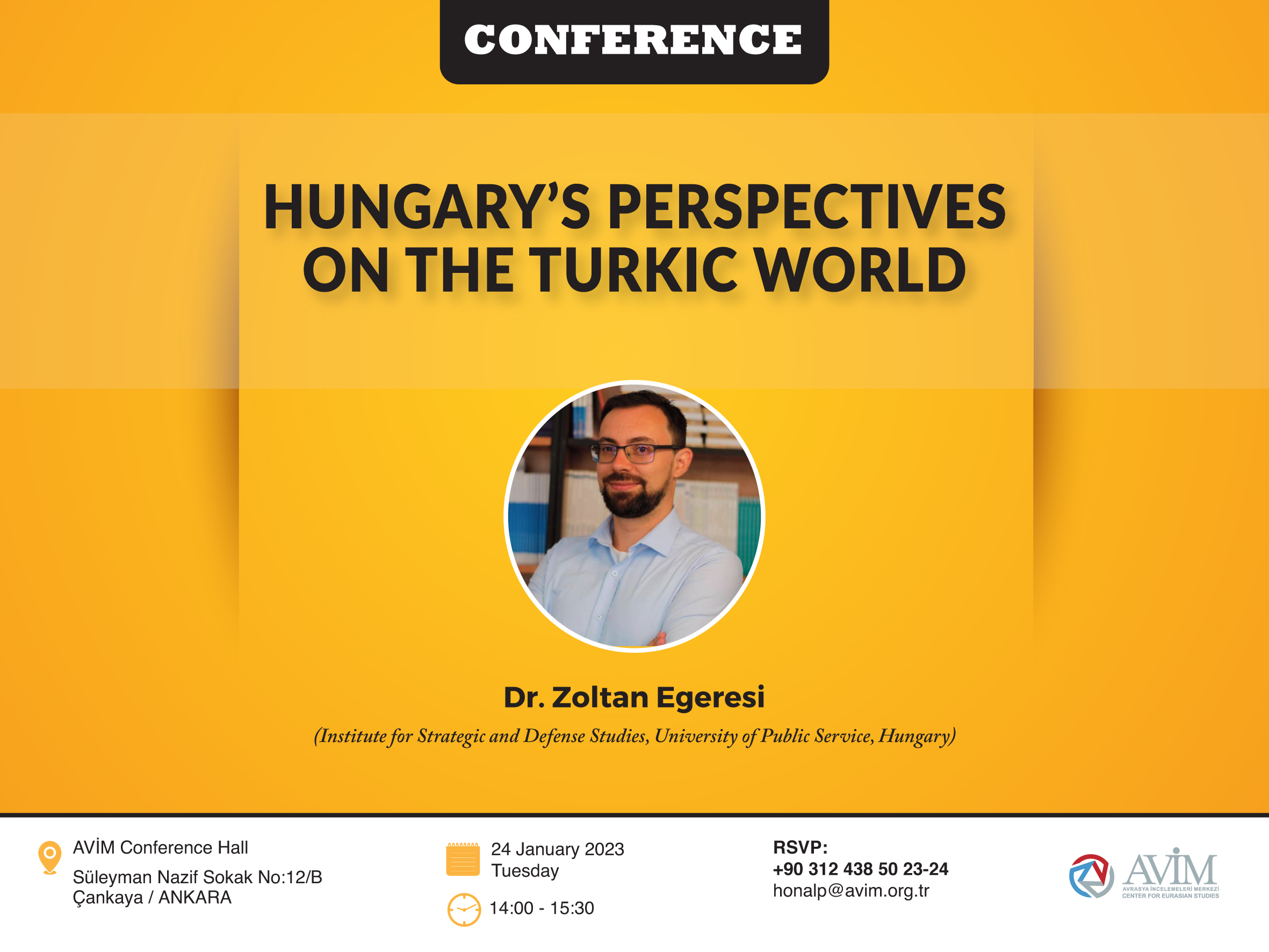
CONFERENCE TITLED “HUNGARY’S PERSPECTIVES ON THE TURKIC WORLD"