

















The Armenian Weekly By Ara Khachatourian on November 18, 2016 in Headline
As soon as Armenia’s newly minted defense minister, Vigen Sargsyan, announced a mandatory tax of 1,000 drams on every Armenian taxpayer to be allocated toward providing benefits for fallen or wounded Armenian soldiers, a vocal wave of opposition began to spring up in political circles, the news media and social networks.
Those opposing the measure clearly state that they are not against the Armed Forces, but question the sudden tariff on citizens who are already burdened by low wages and high taxes. Some even went as far as to challenge the government to urge the super-rich oligarchs, whose questionable earnings and lavish spending have become an eye sore for the not-privileged classes in Armenia.
Having just returned from a brief trip to Armenia, I can attest that the contrast between the haves—the minority—and the have nots is blindingly stark. On the other hand, the four-day war in April and continuing attacks by Azerbaijan make the question of how best to take care of the veterans and their families a critical priority.
A thousand drams is a little more than two dollars. For the Armenian worker earning minimum wage, however, it is a significant amount to be parsed out in a monthly tax, for which the person has not had a chance to budget.
The idea, which minister Sargsyan calls the building of a “nation army,” went from a discussion with President Serge Sarkisian last week to a draft law being debated for several days in the National Assembly.
In briefing representatives of the press on Wednesday, Sargsyan said that the model for this proposal was based on best international practices tweaked to accommodate the unique characteristics of Armenia and Armenians, as well as the security challenges facing the country.
“We often hear that this is the model of Israel, Switzerland or Singapore, but this [his proposal] is Armenia’s model, with all its characteristics and challenges. We must take our path with the hindsight of best practices,” the minister told the media.
“I have advocated the concept of a nation-army from the very first days I was appointed as Defense Minister, and it became a subject for extensive public debate. After 25 years of independence, and of the eve of the 25th anniversary of our army we must move from establishing a national army to a nation-army,” said minister Sargsyan.
“I believe we have traversed a very serious path during these 25 years, and our Armed Forces are the most well established state institution in our country. I am convinced that it is possible to build a nation-army only on the existing principles. I am convinced that these principles are rather well-founded, and thus I made my proposal,” added Sargsyan.
It could be argued that the aforementioned states cited by the defense minister had instituted such a tax from the beginning of their statehood or soon after it was evident that their veterans would require benefits.
When Armenia declared independence 25 years ago it was at war, hence such a tax should have been included in its first if not second iteration of the tax code. Because it was not, thousands of fallen or wounded veterans and their families were deprived of benefits, which, based on this new proposal, are being allocated to the families of soldiers who are killed or wounded in 2017 and beyond.
There is no question that the concept being called “nation-army” must be supported, but the manner in which it is being proposed should be revisited, based on concrete socio-economic considerations and in order to quell valid concerns that a blanket 1,000 drams per taxpayer places the brunt of the burden on those who are struggling to make a living in Armenia.
Two leaders of the Armenian Revolutionary Federation (ARF) Parliamentary faction have taken a proactive approach to the issue. Both Bureau member Armen Rustamyan and Supreme Council of Armenia chairman Aghvan Vardanyan agree that there have been significant shortfalls in addressing the needs of veterans, but warned that a blanket rejection—and criticism—of the effort will not benefit the Armed Forces and the country in general. They also acknowledge that there is clear distrust among the public, but that this effort could be the beginning of an effort to regain the public’s trust.
One of their key approaches is to levy the tax based on the individual’s income, thus elevating a mechanism through which those who earn and pay more taxes are also contributing more to the effort, while those with moderate or low incomes are still participating in the “nation army” process but within their means.
On Wednesday, Vardanyan presented point-by-point concrete alternatives to the current draft, which specifically address the amounts to be paid based on earned wages, as well as mechanisms for governing the fund, which would eliminate concerns of misappropriation and mismanagement.
The two leaders also believe that provisions must be included to ensure that benefits are provided to families who have suffered losses on the battlefield prior to the designated date of 2017 and at least include the families of fallen or wounded soldiers from the four-day war in April.
It behooves the government to approach the matter prudently and pragmatically and take into consideration proposals for amending the existing draft in order for the effort to succeed and not become fodder for further alienation of the population and, most important, the members of the Armed Forces.
Indeed, our Army is the backbone of our Republic and each and every soldier must be nurtured and cared for. If this effort is to succeed, it requires a deeper study of the country’s human and financial resources and not an abrupt, politically-charged adoption of a measure that will not yield the necessary results and will not benefit the brave soldiers of our Armed Forces.
Ara Khatchatourian is the editor of Asbarez (English), where this editorial first appeared.
No comments yet.
- JAPAN PM ABE: WAY TO PEACE TREATY WITH RUSSIA COMING INTO SIGHT Asia - Pacific 21.11.2016
- AZERBAIJAN PREVENTS ARMENIAN PROVOCATION IN BRUSSELS The Caucasus and Turkish-Armenian Relations 21.11.2016
- CHINA, RUSSIA SHOULD PROMOTE ESTABLISHMENT OF FREE TRADE ZONE IN APR - XI Asia - Pacific 21.11.2016
- UK'S HAMMOND SAYS BUDGET OPTIONS CONSTRAINED BY HIGH DEBT Europe - EU 21.11.2016
- ECB CHIEF OUTLINES THREE RISKS STILL FACING EUROZONE RECOVERY Europe - EU 21.11.2016
-
25.01.2016
THE ARMENIAN QUESTION - BASIC KNOWLEDGE AND DOCUMENTATION -
12.06.2024
THE TRUTH WILL OUT -
27.03.2023
RADİKAL ERMENİ UNSURLARCA GERÇEKLEŞTİRİLEN MEZALİMLER VE VANDALİZM -
17.03.2023
PATRIOTISM PERVERTED -
23.02.2023
MEN ARE LIKE THAT -
03.02.2023
BAKÜ-TİFLİS-CEYHAN BORU HATTININ YAŞANAN TARİHİ -
16.12.2022
INTERNATIONAL SCHOLARS ON THE EVENTS OF 1915 -
07.12.2022
FAKE PHOTOS AND THE ARMENIAN PROPAGANDA -
07.12.2022
ERMENİ PROPAGANDASI VE SAHTE RESİMLER -
01.01.2022
A Letter From Japan - Strategically Mum: The Silence of the Armenians -
01.01.2022
Japonya'dan Bir Mektup - Stratejik Suskunluk: Ermenilerin Sessizliği -
03.06.2020
Anastas Mikoyan: Confessions of an Armenian Bolshevik -
08.04.2020
Sovyet Sonrası Ukrayna’da Devlet, Toplum ve Siyaset - Değişen Dinamikler, Dönüşen Kimlikler -
12.06.2018
Ermeni Sorunuyla İlgili İngiliz Belgeleri (1912-1923) - British Documents on Armenian Question (1912-1923) -
02.12.2016
Turkish-Russian Academics: A Historical Study on the Caucasus -
01.07.2016
Gürcistan'daki Müslüman Topluluklar: Azınlık Hakları, Kimlik, Siyaset -
10.03.2016
Armenian Diaspora: Diaspora, State and the Imagination of the Republic of Armenia -
24.01.2016
ERMENİ SORUNU - TEMEL BİLGİ VE BELGELER (2. BASKI)

-
AVİM Conference Hall 24.01.2023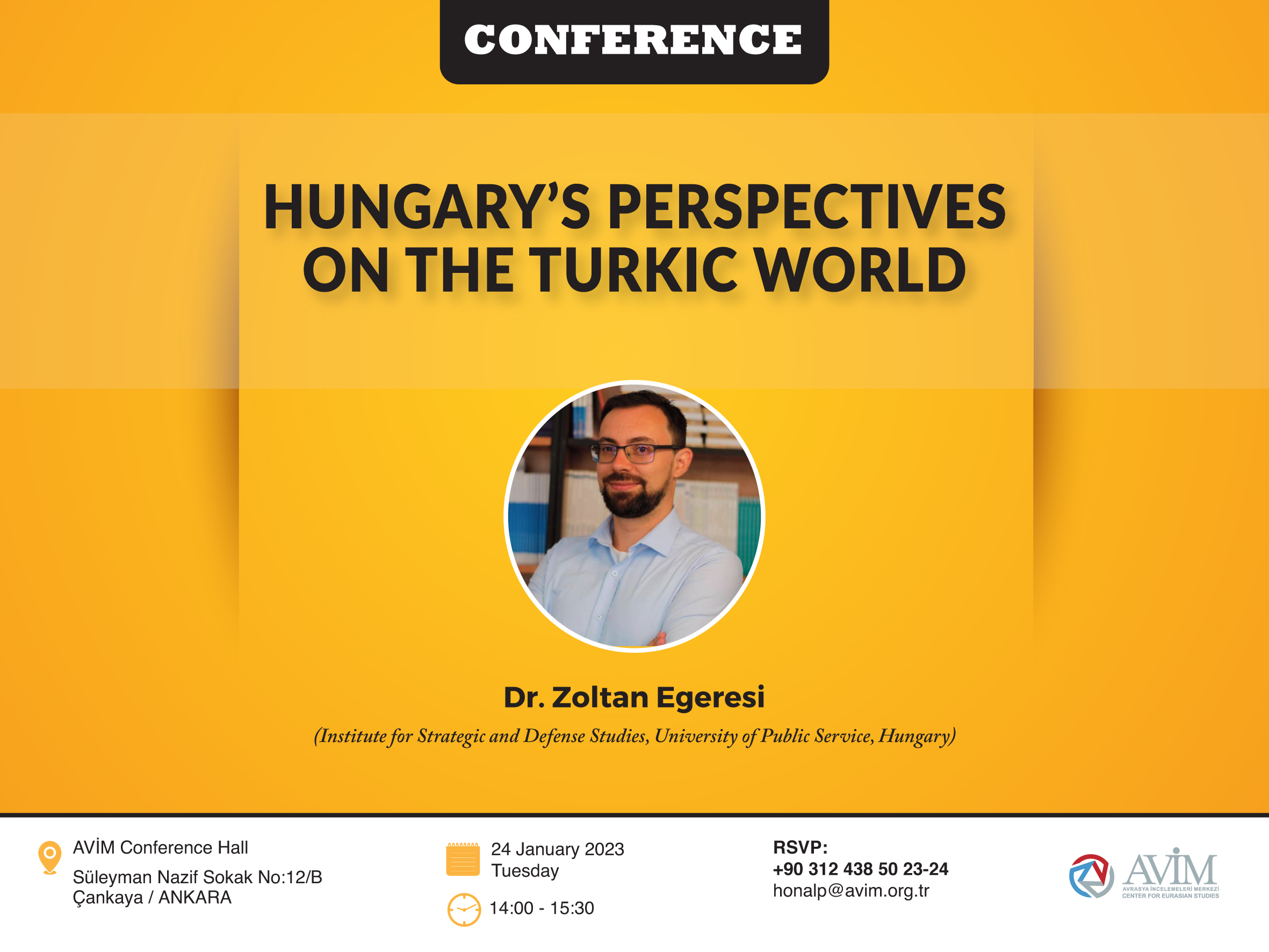
CONFERENCE TITLED “HUNGARY’S PERSPECTIVES ON THE TURKIC WORLD"