

















The National (June 6, 2017)
Iraq is looking to reboot its long-thwarted ambition to push oil output capacity back up among the top ranks of world producers, but it still faces a number of high hurdles.
The country’s oil minister, Jabbar Al Luaibi, last week signalled that the government is ready to push ahead when he picked a new head of upstream after a year-long wait, naming Kareem Hattab, previously head of the Iraq Oil Exploration Company, to the job.
An Iraq oil ministry spokesman says the appointment is one of several Mr Al Luaibi now wants to make as the country’s industry comes through one of its most difficult periods, its finances generally start to stabilise, and with international oil companies ready to start making capital investments again.
There is reason to be sceptical, though, as hopes for Iraq’s production potential have previously been dashed.
Iraq’s giant and super-giant southern oilfields have the reserves in place to allow it to raise output capacity to 10 million barrels per day (bpd)-– which would rank it up with Russia, Saudi Arabia and the US, among the world’s top tier producers – but actual capacity is still about less than half of that and "harsh technical services contract terms and a myriad technical, political and security factors have all conspired to subdue growth," according to Ian Thom, Middle East upstream analyst at energy consultancy Wood Mackenzie.
Iraq’s oil industry has had to contend with decades of war and sanctions. Recovery from the 2003 invasion and its aftermath has been slow and erratic, breaking through 4 million bpd only in 2015 and currently restricted to about 4.35 million bpd under the terms of the Opec deal that Iraq has signed up to through to next March.
The most obvious obstacle the country faces is the war with militants in the west and north. However, the south – where the vast bulk of its oil reserves sit – is relatively free from the violence centred around towns like Mosul, or sporadically spilling into major oil producing areas like Kirkuk in the centre of the country, the dangers are still an obstacle.
Companies cannot ignore the fact that Iraq ranks as the world’s riskiest country for foreign workers with risk-assessing outfits like Verisk and Maplecroft, even if, as Luay Al Khatteeb, head of the Iraq Energy Institute, points out, the instances of violence in the southern part of the country and in the Kurdish region are no more than in Saudi Arabia.
The ongoing conflict has put severe financial restraints on Iraq, which has been exacerbated by the oil price crash and now output restraint.
On Monday, Iraq said it agreed a supplementary budget for this year and next to get US$800 million from the IMF, the second tranche of a $5.35 billion three-year loan deal agreed last December. The country has to keep tight fiscal controls while protecting social spending, but the deficit this year is still projected to be $19bn even with overall spending cut by 6 per cent to $86bn.
This has had a knock-on effect that the international oil companies operating in the south – BP, Royal Dutch Shell, Exxon Mobil, Lukoil, Inpex, etc – have had to restrain investment at the direction of the government, which cannot afford to pay for those investments under the terms of the old contracts.
There is some sign of this loosening up. Earlier this year, Shell tapped oil services company Halliburton to drill a number of development wells at the giant Majnoon field, which it operates. That marked a turnabout from last year when Shell cut back staff sharply from the field and was rumoured to be looking to sell up.
Mr Thom says the government has shown a willingness to negotiate terms of its existing contracts to give companies an incentive to take on more of the risk in return for a greater share of the rewards.
"It’s come to that point where operators have some good leverage with the government to say, ‘look, here is where we want to invest,’ and there could be some discussions to make those investments go ahead within the existing model," he says.
If the investment logjam can be broken there still are some very difficult technical ones to contend with, including a lack of transportation and storage infrastructure, the trend toward more costly and harder-to-market heavy oil and most especially the challenge of bringing in water to provide the pressure needed to boost production.
For the easier-to-access oil, like the Zubair formation at the BP-operated Rumaila field, they have managed to find water solutions, with water coming in from the nearby Shatt Al Arab river. But for the bulk of remaining projects, the inland water system is not sufficient so it has long been planned to bring seawater in via a system of aqueducts and pumps – the estimated $10bn Common Seawater Supply Facility, for which US firm Parsons won the front-end engineering and design contract two years ago.
"The real challenge is [that] they are going to need to integrate the water supply and upstream developments," says Mr Thom. "Bringing it all together and funding it is looking very difficult; but after the midstream projects if you want to expand upstream you need to push on with that."
Mr Al Luaibi has set the relatively modest target of boosting capacity to 5 million bpd by the end of this year. But to make any real progress towards the 9 million bpd he says he wants by 2020, Iraq will probably need to find common ground with the international oil companies who could help make the big infrastructure investments needed.
UN: ISIL kills 163 people in Mosul in one day
'Bodies of murdered Iraqis lay in streets' after ISIL shooting, an apparent bid to prevent civilians fleeing, UN says.
Listen to this page using ReadSpeaker
Share via Facebook
Share via Twitter
Comments
Print
More than 750,000 people have been displaced from Mosul since October [Karim Sahib/AFP]
Fighters from the ISIL (Islamic State of Iraq and the Levant, also known as ISIS) group have killed more than 160 people in one day last week to prevent them from fleeing western Mosul, according to the United Nations.
The agency on Tuesday accused ISIL of carrying out the attack in the group's last stronghold, where a coalition of troops is working to flush out the fighters.
"The brutality of Daesh [ISIL] and other terrorist groups seemingly knows no bounds," said Zeid bin Ra'ad al-Hussein, the UN's human rights chief.
"Yesterday, my staff reported to me that bodies of murdered Iraqi men, women and children still lay on the streets of the al-Shira neighbourhood of western Mosul, after at least 163 people were shot and killed by Daesh to prevent them from fleeing."
INSIDE STORY: When will Mosul be liberated?
Hussein made the comments in his opening address to the UN Human Rights Council.
His spokesman, Rupert Colville, told the AFP news agency that the killings were believed to have taken place on June 1.
In late May, Iraqi forces launched a broad assault on parts of Mosul, closing in on the remaining pockets of territory held by ISIL.
Aid groups had expressed their concerns over the safety of hundreds of thousands of civilians at risk of being caught in the crossfire.
On Monday, UNICEF warned that 100,000 children were still in ISIL-held areas, living under extremely dangerous conditions.
Peter Hawkins, UNICEF's representative in Iraq, said the agency is receiving "alarming reports" of civilians being killed, including children, with some caught in the crossfire while trying to flee.
Separately, Human Rights Watch (HRW) said on Monday that at least 26 bodies of "blindfolded and handcuffed" men were found in government-controlled areas and around the city since the operation started.
READ MORE: UN envoy: Liberation of Mosul from ISIL is 'imminent'
Local armed forces told foreign journalists that 15 men were extrajudicially killed by government forces who were holding them on suspicion of being affiliated with ISIL, the rights group said.
HRW said that in the remaining cases reported by local and international sources, the sites of the apparent executions - all in government-held territory - raise concerns about government responsibility for the killings.
Last month, Stephen O'Brien, the UN under-secretary for humanitarian affairs, said the organisation had "deep concern" for hundreds of thousands of civilians trapped behind ISIL lines.
"Although the UN is not present in the areas where fighting is occurring, we have received very disturbing reports of families being shut inside booby-trapped homes and of children being deliberately targeted by snipers," O'Brien said.
ISIL overran large areas north and west of Baghdad in 2014, but Iraqi forces backed by US-led air raids have since regained much of the territory they lost to the group.
Iraqi forces launched a major operation to retake Mosul in October last year, fighting their way to the city and retaking its eastern side before setting their sights on its smaller but more densely populated west.
The eastern half of Mosul was declared liberated in January and the push for the city's western section, separated from the east by the Tigris River, began the following month.
Almost 10,000 people fled from Mosul's northwest and the Old City every day last week, according to UN estimates.
More than 750,000 people have been displaced from the city since October.
No comments yet.
- US CONTRACTOR CHARGED WITH LEAKING INTELLIGENCE ON RUSSIA HACKING Asia - Pacific 07.06.2017
- IRAQ WAR CRIMES: PHOTOGRAPHER CAPTURES TORTURE, ABUSE AND MURDER — BY THE WRONG SIDE Iraq 07.06.2017
- TRUMP SEEKS LEGISLATIVE WINS TO CAST OFF SHADOW OF RUSSIA PROBES Asia - Pacific 07.06.2017
- CANADIAN FORCES MISSION IN IRAQ AND SYRIA LIKELY TO CONTINUE: GENERAL Iraq 07.06.2017
- KARABAKH CONFLICT CAN BE SOLVED ONLY THROUGH NEGOTIATIONS: LAVROV The Caucasus and Turkish-Armenian Relations 07.06.2017
-
25.01.2016
THE ARMENIAN QUESTION - BASIC KNOWLEDGE AND DOCUMENTATION -
12.06.2024
THE TRUTH WILL OUT -
27.03.2023
RADİKAL ERMENİ UNSURLARCA GERÇEKLEŞTİRİLEN MEZALİMLER VE VANDALİZM -
17.03.2023
PATRIOTISM PERVERTED -
23.02.2023
MEN ARE LIKE THAT -
03.02.2023
BAKÜ-TİFLİS-CEYHAN BORU HATTININ YAŞANAN TARİHİ -
16.12.2022
INTERNATIONAL SCHOLARS ON THE EVENTS OF 1915 -
07.12.2022
FAKE PHOTOS AND THE ARMENIAN PROPAGANDA -
07.12.2022
ERMENİ PROPAGANDASI VE SAHTE RESİMLER -
01.01.2022
A Letter From Japan - Strategically Mum: The Silence of the Armenians -
01.01.2022
Japonya'dan Bir Mektup - Stratejik Suskunluk: Ermenilerin Sessizliği -
03.06.2020
Anastas Mikoyan: Confessions of an Armenian Bolshevik -
08.04.2020
Sovyet Sonrası Ukrayna’da Devlet, Toplum ve Siyaset - Değişen Dinamikler, Dönüşen Kimlikler -
12.06.2018
Ermeni Sorunuyla İlgili İngiliz Belgeleri (1912-1923) - British Documents on Armenian Question (1912-1923) -
02.12.2016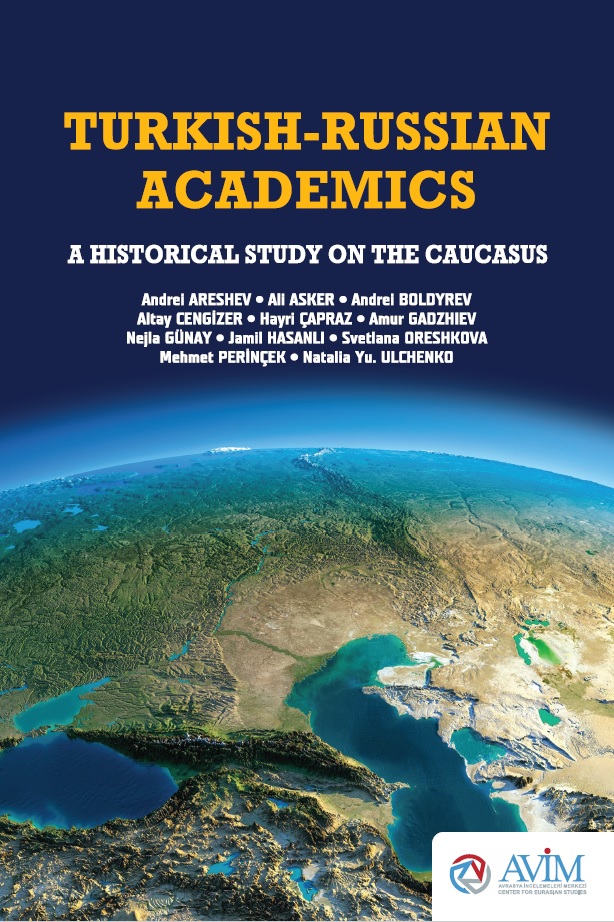
Turkish-Russian Academics: A Historical Study on the Caucasus -
01.07.2016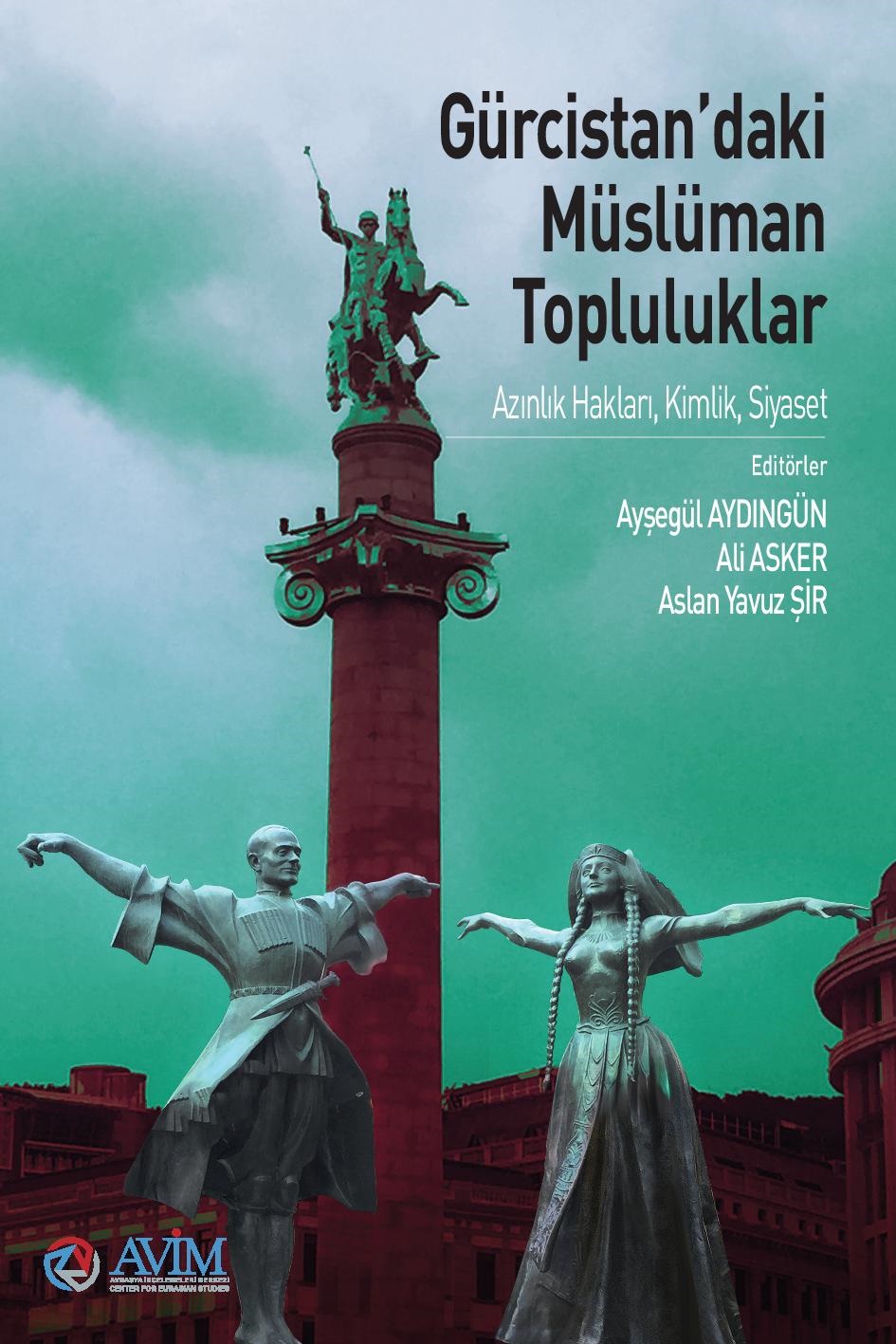
Gürcistan'daki Müslüman Topluluklar: Azınlık Hakları, Kimlik, Siyaset -
10.03.2016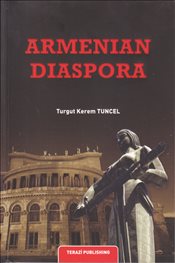
Armenian Diaspora: Diaspora, State and the Imagination of the Republic of Armenia -
24.01.2016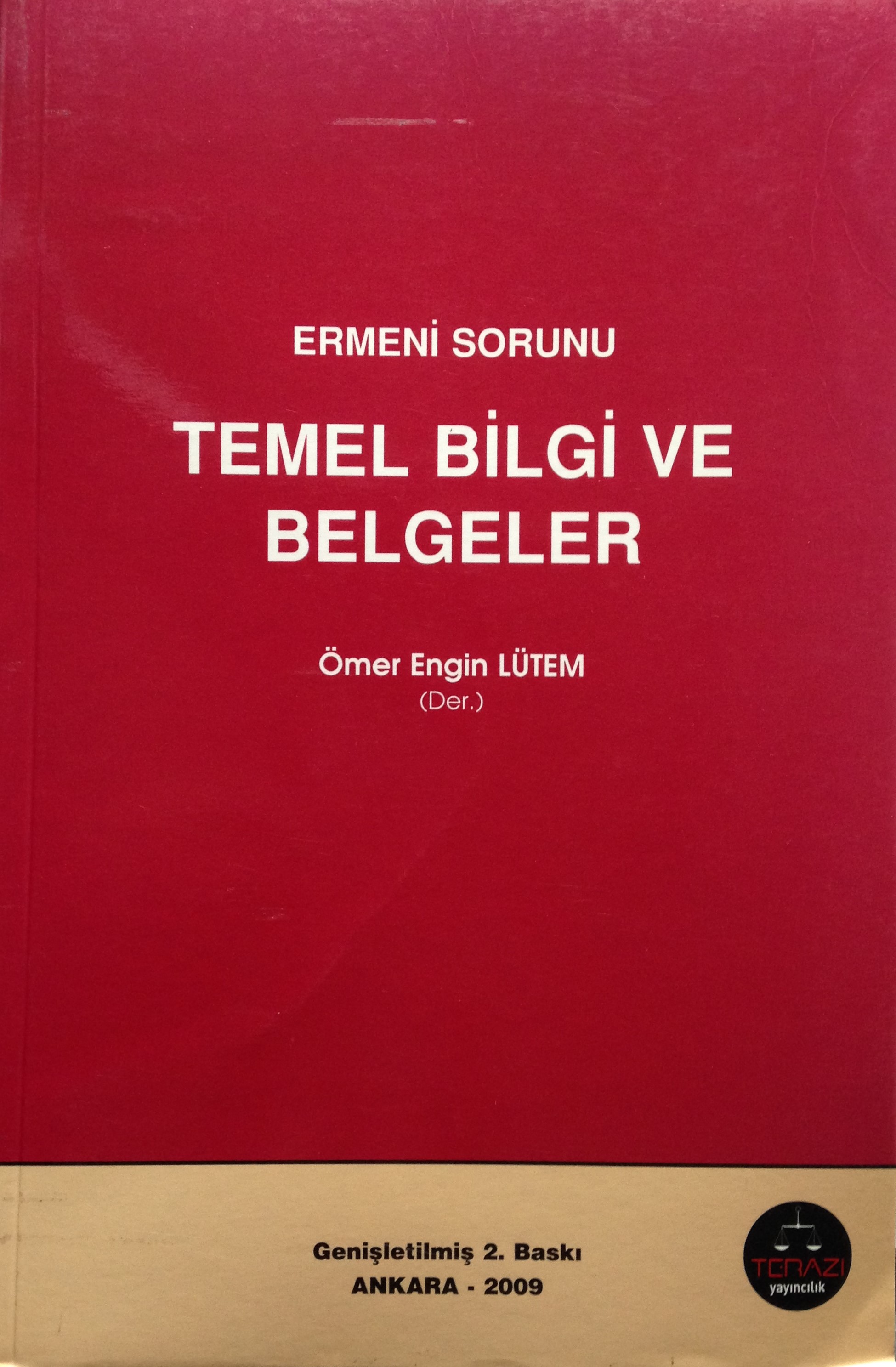
ERMENİ SORUNU - TEMEL BİLGİ VE BELGELER (2. BASKI)
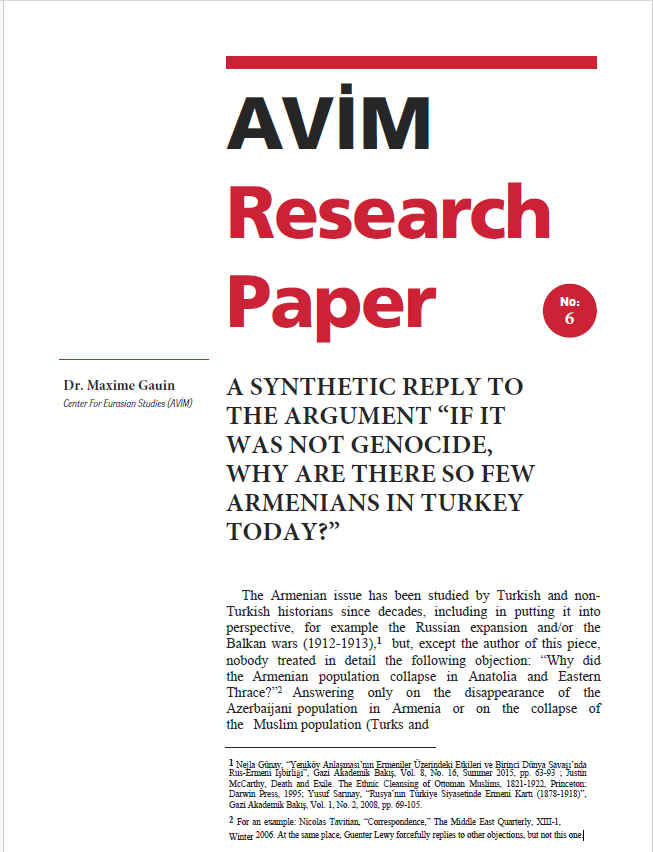
-
AVİM Conference Hall 24.01.2023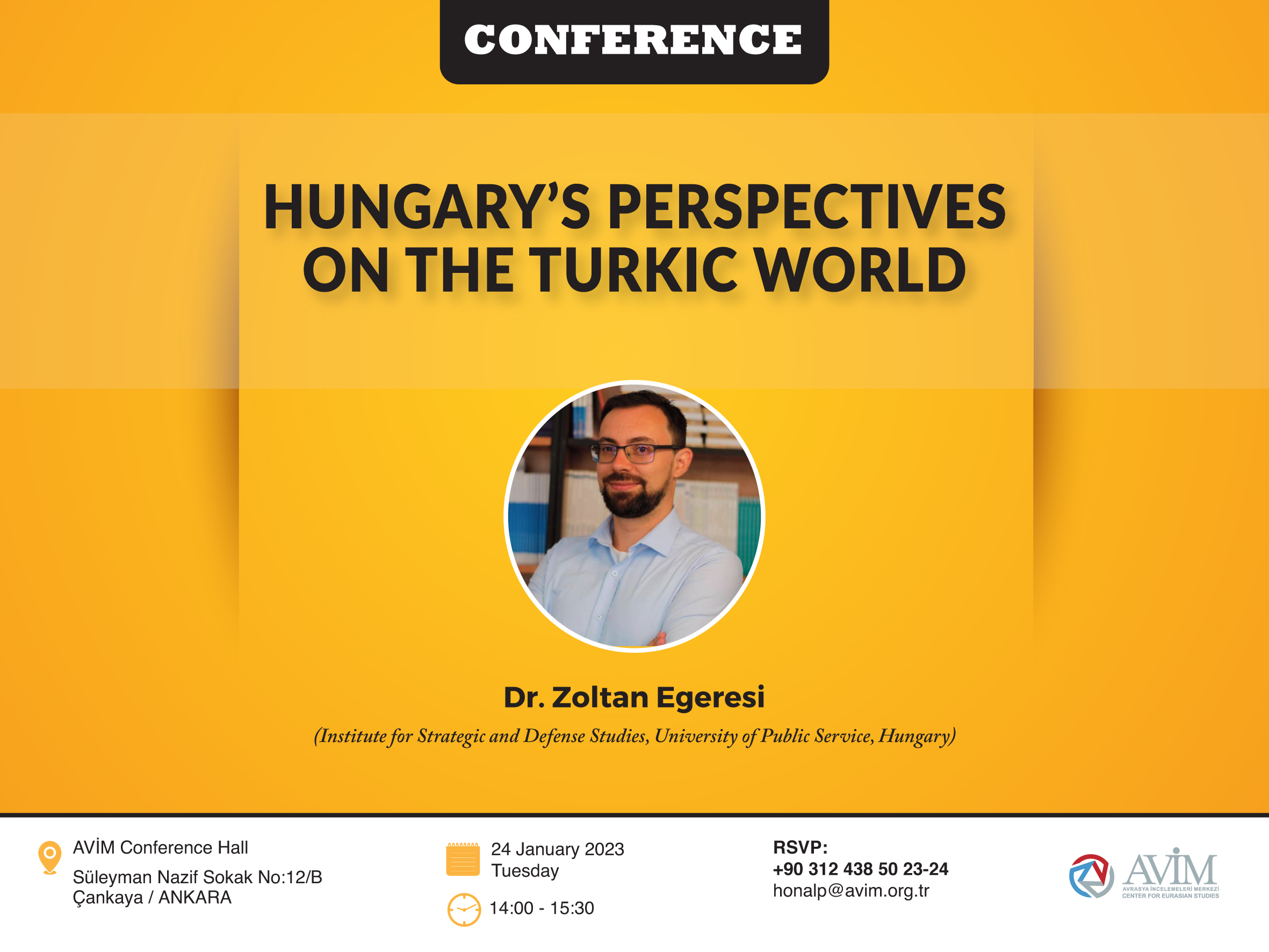
CONFERENCE TITLED “HUNGARY’S PERSPECTIVES ON THE TURKIC WORLD"