

















31.05.2016
EurActiv
Germany’s parliament votes Thursday (2 June) on a resolution that qualifies the massacre of Armenians by Ottoman forces as “genocide”, despite a strong warning from Turkey.
Drawn up by the ruling left-right coalition and the opposition Greens, the resolution entitled “Remembrance and commemoration of the genocide of Armenians and other Christian minorities in 1915 and 1916” also carries the contested word throughout the text.
The vote comes just over a year after President Joachim Gauck became Germany’s highest ranking official to describe the massacre as a “genocide”, drawing a fierce response from Turkey.
GERMAN RESOLUTION ON ARMENIAN GENOCIDE EXPECTED TO SOUR TURKEY RELATIONSIP
Turkey has long opposed the international recognition of the Armenian genocide and the German parliament’s plans to finally grant it could spell trouble for Berlin’s relations with Ankara. EurActiv’s partner Der Tagesspiegel reports.
Its timing is also awkward, as Germany and the European Union need Ankara to help stem a migrant influx even as tensions are rising between both sides over a string of issues, including human rights.
Cautioning against the vote, Turkey’s deputy prime minister and government spokesman Numan Kurtulmus said: “Germany must be careful concerning its relations with Turkey.”
“I do not think that the German parliament will destroy this relationship for the sake of two or three politicians” who had put the resolution before the Bundestag, he added.
Turkey and Armenia have long been at loggerheads over the World War I-era massacre.
Armenians say up to 1.5 million of their kin were killed between 1915 and 1917 as the Ottoman Empire was falling apart and have sought to win international recognition of the massacres as genocide.
“It’s about rendering historical justice, it’s an obligation of the entire international community towards the memory of the victims of the genocide,” Armenian foreign ministry spokesman Tigran Balayan told AFP.
He added that recognition is “important for the prevention of genocides in future”.
Modern Turkey, the successor state to the Ottomans, rejects the claim, arguing that 300,000 to 500,000 Armenians and as many Turks died in civil strife when Armenians rose up against their Ottoman rulers and sided with invading Russian troops.
More than 20 nations, including France and Russia, have recognised the Armenian genocide, but Germany has not.
‘Partial responsibility’
The resolution, which had been in preparation since last year, refers to the atrocities against the Armenians clearly, saying: “Their fate exemplifies the mass exterminations, the ethnic cleansing, the expulsions and indeed the genocides that marked the 20th century in such a terrible way.”
It also states that the “German Empire bears partial responsibility for the events,” a point that Gauck had also made last year.
Germany was then allied with the Ottomans, and deployed soldiers who participated in the deportations of Armenians, Gauck had said.
But a day after Gauck’s speech, Foreign Minister Frank-Walter Steinmeier rejected the use of the term “genocide”, warning that “reducing the issue to the use of the word genocide” would not help overcome “the silence between Turks and Armenians”.
The issue is particularly sensitive in Germany, as it has special ties with Ankara not least due to its three-million-strong ethnic Turkish population which settled there following a massive “guest worker” programme in the 1960s and 1970s.
‘Wrong path?’
Ahead of the vote, around 1,000 people marched Saturday in a protest organised by Turkish groups.
Turkish organisations also sent letters to lawmakers to campaign against the vote, warning of consequences “for peaceful coexistence between Germans and Turks here but also in Turkey”.
Kurds in Germany launched a counter-campaign, flooding Bundestag lawmakers with emails that urged them to withstand Turkish pressure, national news agency DPA reported.
Yet the vote is also divisive within party lines.
The government’s top official in charge of integration, Aydan Oezoguz, has herself warned that it is the “wrong path” to take.
“Those who think that such a move would lead automatically to a rehabilitation in Turkey are wrong. Through this vote, that aim would be pushed further away.”
Nevertheless, party leaders shrugged off any potential impact on relations with Turkey.
The aim is “not to put Turkey in the dock,” Franz Josef Jung, who is the deputy chief of the Christian Democrats group in parliament, told Frankfurter Allgemeine Zeitung daily.
“We are not asking the Turkish government to admit its guilt in the genocide, but for it to recognise its historical responsibility.”
No comments yet.
- IRAQ JOINS MIDEAST RIVALS RAISING OIL EXPORTS AHEAD OF OPEC MEETING Iraq 31.05.2016
- NIKOS KOTZIAS IN BULGARIA FOR SEECP The Balkans 31.05.2016
- IS KAZAKHSTAN ABOUT TO NATIONALIZE MORE URANIUM ASSETS? Asia - Pacific 31.05.2016
- BELGIUM FACING MORE STRIKE CHAOS Europe - EU 31.05.2016
- GM UZBEKISTAN STARTS CHEVROLET AVEO PRODUCTION Asia - Pacific 31.05.2016
-
25.01.2016
THE ARMENIAN QUESTION - BASIC KNOWLEDGE AND DOCUMENTATION -
12.06.2024
THE TRUTH WILL OUT -
27.03.2023
RADİKAL ERMENİ UNSURLARCA GERÇEKLEŞTİRİLEN MEZALİMLER VE VANDALİZM -
17.03.2023
PATRIOTISM PERVERTED -
23.02.2023
MEN ARE LIKE THAT -
03.02.2023
BAKÜ-TİFLİS-CEYHAN BORU HATTININ YAŞANAN TARİHİ -
16.12.2022
INTERNATIONAL SCHOLARS ON THE EVENTS OF 1915 -
07.12.2022
FAKE PHOTOS AND THE ARMENIAN PROPAGANDA -
07.12.2022
ERMENİ PROPAGANDASI VE SAHTE RESİMLER -
01.01.2022
A Letter From Japan - Strategically Mum: The Silence of the Armenians -
01.01.2022
Japonya'dan Bir Mektup - Stratejik Suskunluk: Ermenilerin Sessizliği -
03.06.2020
Anastas Mikoyan: Confessions of an Armenian Bolshevik -
08.04.2020
Sovyet Sonrası Ukrayna’da Devlet, Toplum ve Siyaset - Değişen Dinamikler, Dönüşen Kimlikler -
12.06.2018
Ermeni Sorunuyla İlgili İngiliz Belgeleri (1912-1923) - British Documents on Armenian Question (1912-1923) -
02.12.2016
Turkish-Russian Academics: A Historical Study on the Caucasus -
01.07.2016
Gürcistan'daki Müslüman Topluluklar: Azınlık Hakları, Kimlik, Siyaset -
10.03.2016
Armenian Diaspora: Diaspora, State and the Imagination of the Republic of Armenia -
24.01.2016
ERMENİ SORUNU - TEMEL BİLGİ VE BELGELER (2. BASKI)
-
AVİM Conference Hall 24.01.2023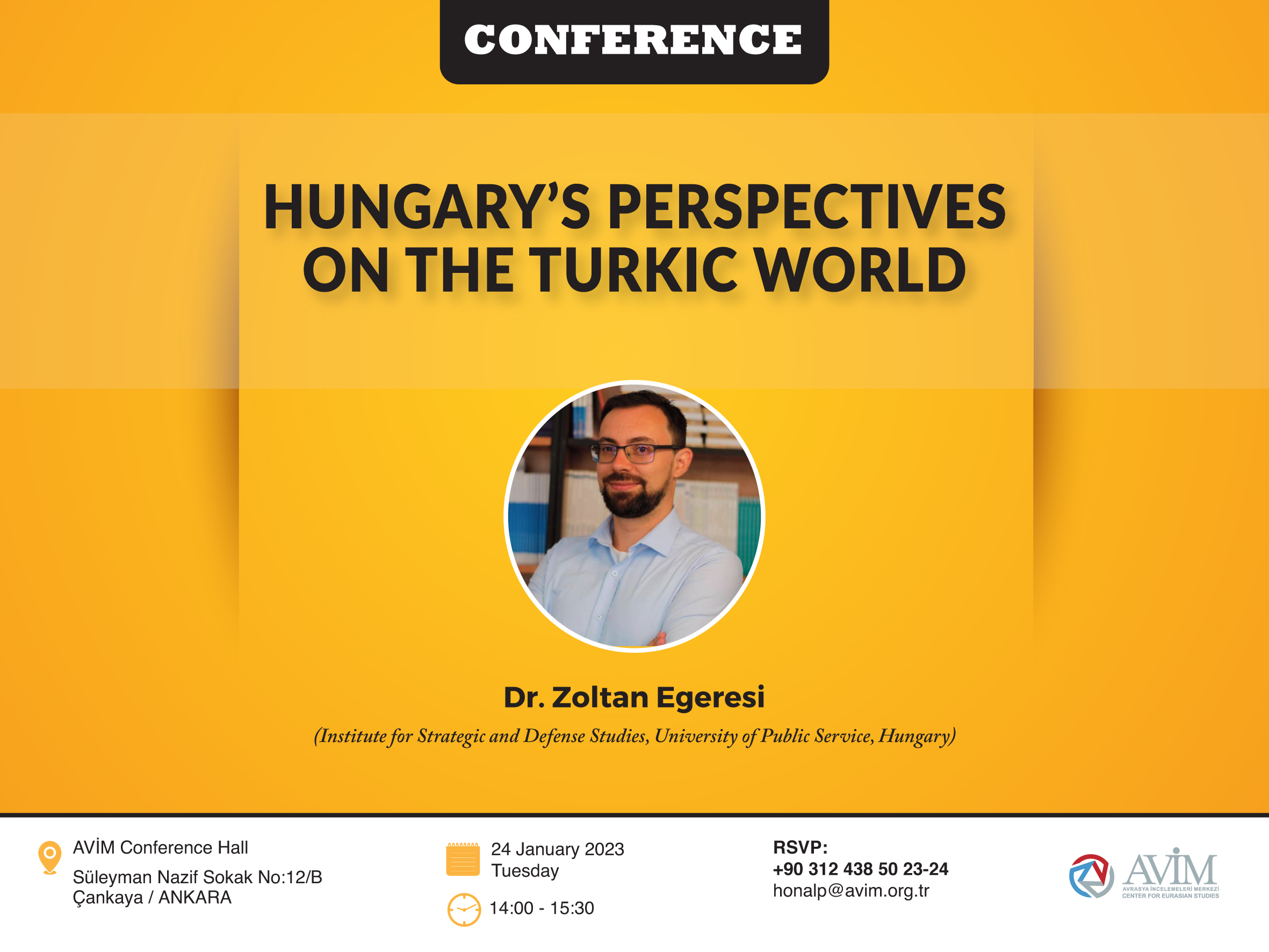
CONFERENCE TITLED “HUNGARY’S PERSPECTIVES ON THE TURKIC WORLD"