

















Eurasianet February 9, 2017
Gayane Abrahamyan
Legislation aimed at preventing domestic violence in Armenia has been scuttled after opponents charged that it is a European attempt to undermine traditional Armenian values.
The draft law, titled “Prevention of and the Struggle against Domestic Violence” was published in November on the website of the Ministry of Justice. The bill would have strengthened laws against domestic violence, and created mechanisms aimed at preventing it, as well as services for its victims. It was introduced as part of a European Union program, under which Armenia would be eligible for 11 million euros in aid, contingent on the country passing a law on domestic violence.
After an immediate outcry, the ministry withdrew the bill the next day, and promised to organize public discussions and elicit citizens’ feedback on the legislation.
“If we think that the Europeans woke up one day and became all of sudden very concerned about Armenian women, then we are gravely mistaken,” Arman Boshian, founder of the Pan-Armenian Parents’ Committee, said at a press conference. Boshian claimed that the bill was a “very dangerous” European attack on Armenian family values.
“The problem is that the issue of domestic violence is more pronounced in Europe. The main aim of the project is the penetration into family, and shattering the traditional roots of our families.” The legislation “introduces direct mechanisms for taking children away from families,” he added.
Supporters of the law, meanwhile, argue that many outspoken opponents of the bill have links to the Russian government, and are, in effect, complicit in a campaign to extend Russian influence across Eurasia.
“The majority of those speaking out against the law, as well as the majority of the media outlets who oppose the law, are clearly pro-Russia, many of them receive grants from Russia,” said Daniel Ioanisian, the head of the Union of Informed Citizens, a pro-Western think tank in Yerevan.
The Union produced a report in December linking Armenian organizations opposing the domestic violence bill, including the Pan-Armenian Parents’ Committee, to the Russian government. “This merely serves as a convenient pretext to boost anti-European sentiments within the wider public, as it is known that family and children remain the sensitive points of our society,” Ioanisian said.
Russia’s parliament recently voted to soften laws against domestic violence. And over the past several years, Russia has pushed a socially conservative agenda in its soft power efforts, arguing that liberal social movements like gay rights are Western ideas foreign to the Eurasian mentality. That idea has been taken up, whether with or without Russian support, across the former Soviet space, not least in Armenia.
“The themes of domestic violence and gender equality are instruments that certain groups in the society, as well as some authorities, use to divert public attention from real social issues and depict the Western democratic values as degenerate,” said Lara Aharonian, the director of the Women’s Resource Center and a women’s rights activist in Yerevan.
About 60 percent of Armenian women reported that they had suffered from domestic violence at least once in their lives, according to a 2011 survey conducted by the Organization for Security and Cooperation in Europe. In the last seven years, 30 women were murdered in cases of domestic violence; in seven of those cases, the murder took place with children present, according to the advocacy group Coalition Against Domestic Violence.
The Armenian government has disputed claims that the law would take children away from families; the legislation does not in fact address child custody, which is already dealt with in other parts of Armenian law.
“This is clear disinformation; the law has nothing to do with taking children away from their families: to the contrary, it stipulates a clear mechanism for protecting children’s rights and preventing domestic violence. This is what is missing today; often the police lack the ability to exercise any preventive measures,” said Bagrat Ghazinian, an adviser to the Minster of Justice, in an interview with EurasiaNet.
This is not the first time Armenian social issues have gotten caught up in geopolitics. In 2013, a contentious public debate erupted about a so-called “Gender Equality Law,” with opponents painting the law as a European promotion of non-traditional gender roles. That debate got enmeshed in a separate debate about whether to sign an association agreement with the European Union, or to instead join the Russia-led Eurasian Economic Union. Ultimately, the gender bill was passed – albeit with a different name, which excluded the word “gender” – and Armenia opted for the Eurasian Union.
The same year, after a strong public backlash against raising prices on transportation, the speaker of Armenia’s parliament, Galust Sahakian, called on protesters “to struggle against the gay rights agenda, instead of the price hike.”
In 2013, “the wave of misrepresentation of European values began,” said Styopa Safarian, a political analyst and the head of the Armenian Institute of International and Security Affairs. “Those events were carefully exploited by certain groups in order to equate European values with gender and LGBT issues, and to sabotage the signing of the association agreement,” Safarian said.
“During those days, pro-Russian circles were actively involved in that propaganda; they were arguing that by signing the Association Agreement we would be accepting gay rights, and organizations that were dealing with women issues were deliberately targeted,” Safarian added.
That pattern has repeated itself with the current debate, said Karine Achemian, an MP from the ruling Republican Party, in an interview with EurasiaNet.org. “The impression I drew from discussions in parliament was that many members weren’t concerned about supporting the victims of domestic violence, but in accusing one another,” Achemian said. “This has turned into a struggle between pro-Russian and pro-European forces. The same happened in 2013 during the discussions of the law on Gender Equality, when, instead, we should have focused on the law and creating real mechanisms for supporting the families.”
No comments yet.
- TURKEY REITERATES PRECONDITION FOR OPENING BORDER WITH ARMENIA The Caucasus and Turkish-Armenian Relations 13.02.2017
- AS TRUMP RE-EVALUATES NATO, NATO MUST RETHINK RUSSIA Asia - Pacific 13.02.2017
- GEORGIA, AZERBAIJAN SUPPORT EACH OTHER’S TERRITORIAL INTEGRITY: FM JANELIDZE The Caucasus and Turkish-Armenian Relations 13.02.2017
- BOSNIA REPORTS FIRST CASE OF H5N8 BIRD FLU The Balkans 13.02.2017
- 25 YEARS PASS SINCE OCCUPATION OF MALIBEYLI, GUSHCHULAR VILLAGES OF AZERBAIJAN’S SHUSHA The Caucasus and Turkish-Armenian Relations 13.02.2017
-
25.01.2016
THE ARMENIAN QUESTION - BASIC KNOWLEDGE AND DOCUMENTATION -
12.06.2024
THE TRUTH WILL OUT -
27.03.2023
RADİKAL ERMENİ UNSURLARCA GERÇEKLEŞTİRİLEN MEZALİMLER VE VANDALİZM -
17.03.2023
PATRIOTISM PERVERTED -
23.02.2023
MEN ARE LIKE THAT -
03.02.2023
BAKÜ-TİFLİS-CEYHAN BORU HATTININ YAŞANAN TARİHİ -
16.12.2022
INTERNATIONAL SCHOLARS ON THE EVENTS OF 1915 -
07.12.2022
FAKE PHOTOS AND THE ARMENIAN PROPAGANDA -
07.12.2022
ERMENİ PROPAGANDASI VE SAHTE RESİMLER -
01.01.2022
A Letter From Japan - Strategically Mum: The Silence of the Armenians -
01.01.2022
Japonya'dan Bir Mektup - Stratejik Suskunluk: Ermenilerin Sessizliği -
03.06.2020
Anastas Mikoyan: Confessions of an Armenian Bolshevik -
08.04.2020
Sovyet Sonrası Ukrayna’da Devlet, Toplum ve Siyaset - Değişen Dinamikler, Dönüşen Kimlikler -
12.06.2018
Ermeni Sorunuyla İlgili İngiliz Belgeleri (1912-1923) - British Documents on Armenian Question (1912-1923) -
02.12.2016
Turkish-Russian Academics: A Historical Study on the Caucasus -
01.07.2016
Gürcistan'daki Müslüman Topluluklar: Azınlık Hakları, Kimlik, Siyaset -
10.03.2016
Armenian Diaspora: Diaspora, State and the Imagination of the Republic of Armenia -
24.01.2016
ERMENİ SORUNU - TEMEL BİLGİ VE BELGELER (2. BASKI)
-
AVİM Conference Hall 24.01.2023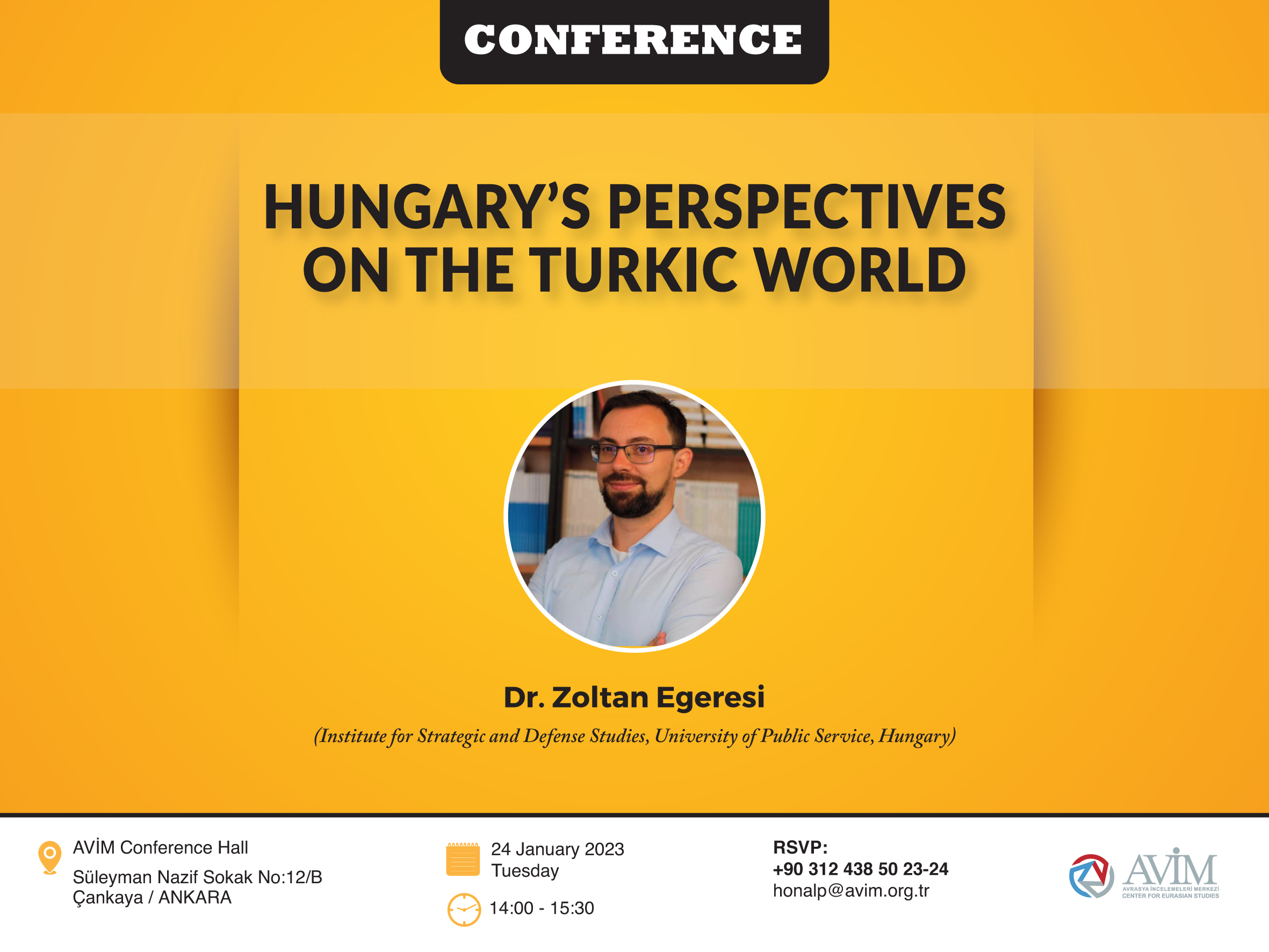
CONFERENCE TITLED “HUNGARY’S PERSPECTIVES ON THE TURKIC WORLD"