NEW ARTICLE ANNOUNCEMENT: FROM SARIKAMIŞ TO 1915 - AN EXAMINATION OF THE “SCAPEGOAT” NARRATIVE
Download PDF :

Dr. Erman Şahin’s article “The Sarıkamış Campaign, Enver Pasha and Armenians,” published in Middle Eastern Studies, subjects to documentary scrutiny a narrative long entrenched in the literature that associates the Sarıkamış campaign on the Caucasus Front of the First World War with the events of 1915. The study examines the widely shared thesis that Ottoman Minister of War Enver Pasha and the Committee of Union and Progress (CUP) placed responsibility for the Sarıkamış defeat on the Armenians, thereby furnishing the rationale for the measures of 1915, and demonstrates that this thesis finds no support in primary sources.
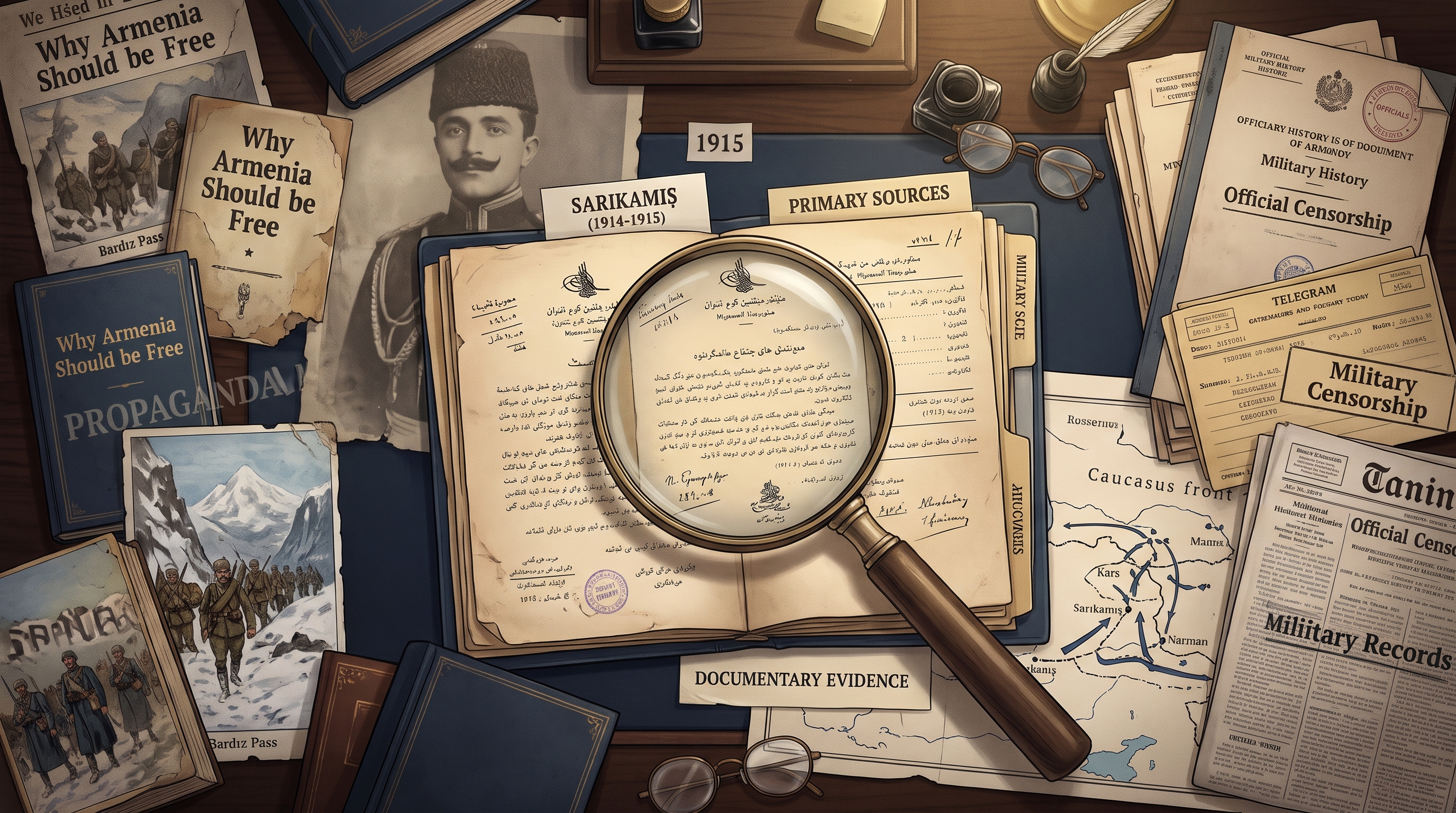
The “scapegoat narrative” repeatedly invoked in the literature first assumed concrete form in Garegin Pasdermadjian’s postwar propaganda volume Why Armenia Should be Free. Pasdermadjian claimed that the Armenian volunteer battalion commanded by Arshak Kavafian (Keri) delayed the Ottoman advance for twenty-four hours at Bardız Pass, thereby saving the Russian army, and that Enver Pasha, upon his return to Istanbul, publicly proclaimed this “service” and attributed the defeat to the Armenians. Herbert Adams Gibbons restated the account in nearly identical language. Subsequently, Vahakn N. Dadrian, Şuhnaz Yılmaz, Donald Bloxham, Ronald Grigor Suny, Fatma Müge Göçek and numerous other scholars advanced similar assertions either without citation or by relying exclusively on secondary propaganda texts such as those of Pasdermadjian and Gibbons. Dr. Şahin establishes that, notwithstanding the apparent breadth of this consensus, not a single direct statement by Enver Pasha linking the defeat to the Armenians has been located.
Through a comparative analysis of Ottoman, Russian and Armenian sources, the article reconstructs the course of the campaign. Official Turkish General Staff histories (the works of Fahri Belen and of Hakkı Altınbilek and Naci Kır), the military histories and reports of Russian generals, and an internal communication dated 9 January 1915 by Dashnak leader Simon Vratsian yield an identical picture: the 4th Armenian Volunteer Battalion encountered the Ottoman 31stDivision in the vicinity of Narman on 22 December, proved unable to execute an effective delaying action, scattered, and withdrew toward Kars. No Armenian volunteer unit was present at Bardız Pass, and Ottoman forces seized the pass without delay. Pasdermadjian’s assertions of “600 fallen Armenians” and a “24-hour delay” stand in contradiction to the documentary evidence. The earlier warnings of American military historian Edward J. Erickson that these claims were unfounded are here reinforced by Dr. Şahin with primary documentation.
The article further underscores the internal inconsistencies of the narrative. Before departing the front, Enver Pasha requested of the Grand Vizier that all details of the defeat be suppressed; the ensuing strict censorship prevented the Ottoman public from learning of the Sarıkamış disaster until the end of the war. It is logically impossible simultaneously to conceal a defeat and to publicize it by designating the Armenians as scapegoats. Of the sixteen items concerning Armenians published in the CUP newspaper Tanin between the aftermath of Sarıkamış and 21 July 1915, seven were positive or laudatory and nine neutral; none attributed the defeat to the Armenians. A comparable pattern is observable across the Ottoman press as a whole. Among 108 distinct newspaper reports on the Caucasus Front and the Sarıkamış campaign appearing during and after the operation, not one contained statements adverse to the Armenians. On the contrary, in the interest of preserving internal order and peace, the Ottoman authorities censored information and news regarding the participation of Ottoman Armenians in volunteer units as well as massacres and other acts of violence perpetrated against Muslims in occupied regions both before and after Sarıkamış. Official communiqués and newspapers conveyed solely messages of unity and solidarity with respect to the Armenians. This stance continued until the summer of 1915, when relations reached a point of rupture. These findings demonstrate that narratives asserting—without any supporting evidence—that the Armenians were designated as scapegoats are fundamentally erroneous. In June 1915 the Ottoman government issued an official statement, widely circulated by news agencies, enumerating its grievances against the Allies and the Armenians; this statement contained no reference whatsoever to Sarıkamış. Collectively, the evidence weakens the thesis that the 1915 measures were triggered by the attribution of the Sarıkamış defeat to the Armenians.
Dr. Şahin’s study tests, in the light of primary sources, Sarıkamış as a “threshold event” claim frequently reiterated in the international literature on the events of 1915. It shows that this claim originates in postwar propaganda texts and is unsupported by Ottoman, Russian or Armenian documents. The article further emphasizes that, from the standpoint of the Ottoman administration, the principal significance of the Armenian volunteer units lay not in any tactical achievements on the battlefield but rather in their connection to desertions, guerrilla and insurgent activities, and violence directed against the Muslim population in occupied territories. In this manner, it presents, on the basis of concrete documentary evidence, a framework according to which the 1915 measures rested upon military and security considerations rather than upon an endeavour to designate the Armenians as scapegoats.
The study demonstrates that the exaggeration of a causal connection between the Sarıkamış campaign and the events of 1915 is incompatible with the historical record and recalls the necessity of returning scholarly discussion to primary sources. Written in an objective and scientific manner, Dr. Şahin’s article constitutes a significant contribution by refuting, on documentary grounds, one of the fundamental assumptions underlying unsubstantiated accusations directed against Turkey in the context of 1915.
In the conclusion section, the article makes the following points:
“As Italian philosopher and astronomer Giordano Bruno wrote, ‘If the first button of one’s coat is wrongly buttoned, all the rest will be crooked.’ Pasdermadjian’s pamphlet was the first button: a piece with a transparent agenda, riddled with factual errors that a basic knowledge of the battle would have flagged as unreliable. No scholar independently verified Pasdermadjian’s claims. Yet, departing from his flawed work or borrowing from one another, many scholars offered arguments that were inherently flawed and speculative, lacking any foundation in Ottoman leaders’ actual statements. The often-repeated idea that Enver had used Armenians as scapegoats for the Sarıkamış defeat lacks factual basis and warrants no further repetition in the scholarly literature.”
Dr. Erman Şahin’s article was published in Middle Eastern Studies on 1 November 2026. The full text may be accessed at: https://doi.org/10.1080/00263206.2026.2754161