













This is the English translation of a Turkish language article that was originally published by AVİM on 15 October 2025.
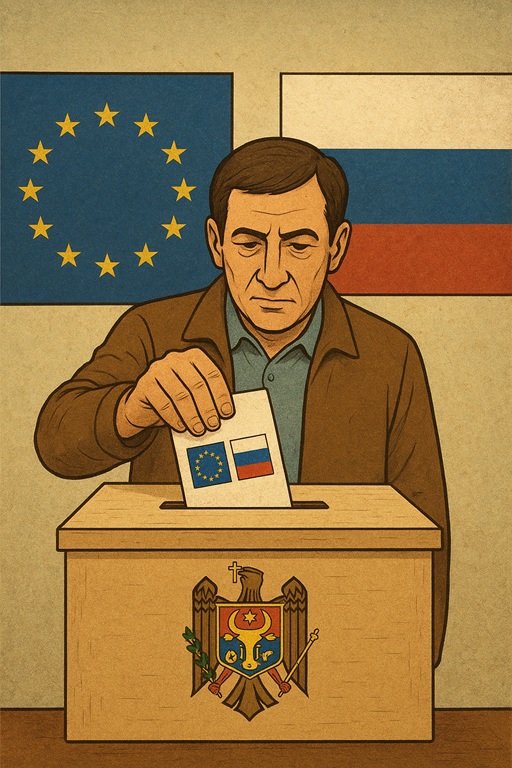
In the parliamentary elections held on 28 September in Moldova, President Maia Sandu’s Party of Action and Solidarity (PAS) has taken 55 of the 101 seats in the parliament with a 50.2% majority, while the Patriotic Electoral Bloc (PEB), consisting of four parties, has gained 26 seats with 24.17%. Evaluated as a choice between Moscow and Brussels in the Western media and public opinion, the election results have thus been interpreted as a victory for Brussels and Ukraine. Prior to the elections, after President Sandu accused the Kremlin of spending hundreds of millions of euros to spread disinformation, the police raids were carried out based on the claims that Russia was coordinating with criminal elements to destabilize the country and incite massive riots, which resulted in two pro-Russian parties being banned from participating in the elections based on allegations of voter bribery, illegal party financing, and money laundering. The European Union (EU) also showed its position, as the Spokesperson of the European Commission argued that Russia had deeply interfered in the elections. Had a pro-Russian party won the elections instead of the pro-EU party in an environment where the Ukraine-Russia War is still ongoing, it would have been interpreted by the EU as a major crack within the eastern front and as the encirclement of Ukraine.[1] By looking at this picture, it can be said that the main factor that determined the atmosphere in which the elections were held was not the differentiations within the domestic politics of Moldova, but rather a struggle over the geopolitical positioning between the blocs.
Moldova Confronted with Geopolitical Entrapment
When looking at Moldova’s geopolitical location, it will be seen that Ukraine is located along the north, east, and south-eastern borders, while Romania is located at the western border where the Prut River flows. In the eastern part of Moldova, there is the breakaway region of Transnistria, separated from Moldova by the Dniester River. Functioning as a bridge between Ukraine and the Balkans, Moldova -as an Eastern European country- carries geopolitical significance. Because of its location, the country represents one of the regions where the competition between NATO and EU on one side, and Russia on the other side becomes apparent. Moldova, which can be considered within the Orthodox and Slavic sphere of influence, faces important issues in need of a resolution; some of which have a historical background. These problems can be listed as the mismatch of its political borders with its historical and ethnic borders, the ambiguity of its national identity (Romanian vs. Moldovan), lack of security and stability, economic crises and unemployment-driven external immigration, the active Russia factor in the region, and the case of unification with Romania.[2]
Moldova, which can be defined as a buffer zone between East and West, is in the sphere of interest of the US and EU on the one hand, and in the sphere of interest of Russia on the other hand. The geographic location has rendered Moldova vulnerable and defenseless against security threats. Affected frequently by the wars and conflicts between the states that were accepted as a great power over the course of history in different periods, the country has developed a stance towards the prevention of new conflicts in its region. This geopolitical strategy has been identified as “dual alignment” by some researchers. While both the EU and Russia use their networks to influence the local elections as international actors, Moldovan society has also been divided into two: pro-Russians on the one hand, and pro-EU ones on the other hand.[3] Stuck between the EU and Russia, the former Soviet republic has been defined as a contentious area, and both the EU and Russia have used soft power elements in order to strengthen their position within the regional order and attract Moldova to their sides.[4]
Moldova’s Integration Policy with the EU
Moldova applied to EU membership in March 2022 and gained candidate status in June 2022. The accession negotiations were officially opened in June 2024. Also, the EU and Moldova cooperate within the scope of the Eastern Partnership.[5] Along with this, a referendum was held in October 2024 regarding the amendment of Moldova’s constitution in the context of complying with the requirements of EU membership, and in a close call, resulted in favor of joining the EU. The votes of the Moldovans living in the US, Canada, and Europe played a decisive role in the referendum.[6] PAS, which is currently in power in Moldova, places its trust in the Diaspora, which forms PAS’ basic support base. In the presidential elections, 83% of the 330,000 voters living abroad supported Sandu in the second round, and in this parliamentary elections, 30% more ballot boxes were opened compared to the previous election. In addition, PAS has push a geopolitical narrative that argues that the preference between East and West will determine Moldova’s fate.[7] Being in the opposition, PEB and Şor Party-related movements constituting the pro-Russian block present the integration with the EU as a threat to national independence.[8] The victory of PAS’ pro-EU agenda is a confirmation of the country’s EU-orientation, and demonstrates that the EU continues to increase its impact in Eastern Europe. However, saying that this also represents a disengagement from Russia would be a hasty comment.
Russia’s Influence in Moldova and Moldova’s Energy Dependency
Since Russia sees Moldova as its own near abroad, it perceives the eastern enlargement of the EU as a threat. The efforts of Brussels’ enlargement towards the post-Soviet geography are seen by Moscow as an encirclement of Russia that is dismissive of the Russian spheres of influence, and which prompts Russia to engage in retaliatory actions.[9]
Moldova’s trade in goods with Russia has decreased dramatically, falling to approximately 2.5% of the country’s total trade in goods. This rate is 9.8% for China, 11.1% for Ukraine, and 54%for the EU. Despite this, Moldova’s energy dependency on Russia continues. One of the essential bases of Russia’s influence on Moldova is therefore the supply of energy. Moldova imports most of its energy, with Russia the dominant figure in the supply of petrol and gas. Even though Moldova has stopped purchasing gas directly from Russia after the Ukraine-Russia War, approximately 70 percent of the country’s electricity, coming from Ciciurgan power station in Transnistria, is still produced by obtaining Russian gas.
Transnistria and Gaguzia
In the aftermath of the war that occurred in 1992 after the dissolution of the Soviet Union, the Transnistria/Pridnestrovian Moldovan Republic unilaterally declared its independence from Moldova. As a de facto independent region, Transnistria is supported by Russia both militarily and economically. Pro-Russian politicians in Moldova allege that the Central Electoral Commission discriminates against Moldovan citizen voters in Transnistria. By doing so, approximately 750,000 voters living in Russia and Transnistria, who are considered to be supporters of pro-Russian parties, are being prevented from voting in the elections. After Sandu’s victory in the elections, it is also anticipated she will attempt to dissolve both Transnistria and the Gaguzia administrations.[10]
Gaguzia is an autonomous region inhabited by a Turkic population within the territory of the Republic of Moldova. While the Gaguzia people voted 95 percent against the EU in the 2024 referendum, they also supported pro-Russian parties in the 2025 elections. Gaguzia is seen by Russia as a part of the Russian world (Russkiy mir). Gagauz Turks living in the southern part of the country are not welcoming toward Romania’s historical goal of unification with Moldova. In this context, it should be recalled that the President of Gaguzia Autonomous Region, Evghenia Gutul, was arrested in Moldova on the grounds of transferring money from Russia to the banned Şor Party.
Conclusion
In conclusion, the last parliamentary elections in Moldova were not only a reflection of the country’s domestic dynamics but also of the broad geopolitical rivalry between Russia and the European Union. Though the victory of the Party of Action and Solidarity (PAS) confirms Moldova’s determination towards integration with the EU, it is too early to state that this orientation means a definitive disengagement from Russia. Moldova’s institutional, economic, and juridical reforms within the process of EU membership carry the potential to solve the country’s chronic economic, social, and political problems. However, the election results showcase that the society is clearly divided between pro-Western and pro-Russian parts, and this situation reveals a social fault line that should be handled with care in terms of Moldova’s political stability. On the other hand, Gagauz Turks in Moldova constitute a significant part of both the multicultural structure of the country and the regional power balances. In terms of Türkiye, the improvement of cooperation towards the preservation of the language and culture of the Gagauz Turks, the preservation of their identities, and security of their rights is not only be a cultural responsibility, but also a strategic move contributing to regional peace and stability. In this aspect, the future of Moldova seems to depend on both the successful implementation of the reform processes that have deepened with the orientation towards Europe and preserving the country’s inner societal coherence and multicultural structure.
[1] Rikard Jozwiak, “Moldova's Pro-EU Election Result A Win For Brussels As Much As Chisinau,” RFE/RL, 29 September 2025, https://www.rferl.org/a/moldova-eu-election-result-win-brussels-chisinau/33543650.html.
[2] Müberra Koçyi̇ği̇t Türk, “Jeopolitik Açıdan Moldova’nın Toprak Bütünlüğü ve Bölgesel-Küresel Aktörlerin Etkisi,” Journal of Suleyman Demirel University Institute of Social Sciences, no. 50 (1 Eylül 2024): 1–29. https://research.ebsco.com/linkprocessor/plink?id=1ce08708-996e-3493-bd61-2f606befc703.
[3] Roxana-Maria Nistor, “Shaping Minds through Discourse: Propaganda Narratives in Moldova’s 2024 Elections,” Online Journal Modelling the New Europe, no. 46 (1 December 2024): 190–210. doi:10.24193/OJMNE.2024.46.09.
[4] Johannes Wetzinger, “The Geopolitics of Higher Education: The Case of Moldova between the EU and Russia,” Policy Reviews in Higher Education 6, no. 2 (1 January 2022): 205–29. doi:10.1080/23322969.2022.2101506.
[5] “Moldova,” the Council of the EU and the European Council, https://www.consilium.europa.eu/en/policies/moldova/.
[6] Gabriel Gavin, “Moldova votes yes to joining EU by tiny margin,” Politico, 21 October 2024, https://www.politico.eu/article/moldova-votes-yes-join-european-union/.
[7] Ondrej Ditrych, “The Moldovan parliamentary election: Chișinău has dodged the bullet this time, but dangers to democracy remain,” EUISS, 29 September 2025, https://www.iss.europa.eu/publications/commentary/moldovan-parliamentary-election-chisinau-has-dodged-bullet-time-dangers.
[8] Florent Parmentier, “Moldova's Crucial Parliamentary Election. What's at Stake?”, IFRI, 22 September 2025, https://www.ifri.org/en/memos/moldovas-crucial-parliamentary-election-whats-stake.
[9] Emrah Dokuzlu, “Moldova seçimleri: Rusya-AB rekabetinde yeni bir cephe mi?,” Anadolu Ajansı, 8 Ekim 2025, https://www.aa.com.tr/tr/analiz/moldova-secimleri-rusya-ab-rekabetinde-yeni-bir-cephe-mi/3710958.
[10] Erkin Öncan, “Moldova'da seçimler yaklaşırken: Transinyester'e saldırı iddiaları ne anlama geliyor?,” Independent Türkçe, 19 Eylül 2025, https://www.indyturk.com/node/765071/haber/moldovada-se%C3%A7imler-yakla%C5%9F%C4%B1rken-transinyestere-sald%C4%B1r%C4%B1-iddialar%C4%B1-ne-anlama-geliyor.
© 2009-2025 Center for Eurasian Studies (AVİM) All Rights Reserved
No comments yet.
-
 DEVELOPMENTS IN LINE WITH TÜRKİYE’S GOAL OF BECOMING A REGIONAL ENERGY HUB
Bekir Caner ŞAFAK 24.02.2025 -
 ARMENIA’S NUCLEAR DILEMMA: CAUGHT BETWEEN RUSSIA AND THE WEST
Bekir Caner ŞAFAK 12.11.2025 -
 THE INCREASING IMPORTANCE OF TURKSTREAM FOLLOWING KIEV'S SUSPENSION OF RUSSIAN GAS SHIPMENT TO EUROPE
Bekir Caner ŞAFAK 17.01.2025 -
 REVIVAL OF THE QATAR-TÜRKİYE NATURAL GAS PIPELINE PROJECT
Bekir Caner ŞAFAK 16.04.2025 -
THE MOLDOVA ELECTIONS AND GAGAUZIA AS A POLITICAL REFLECTION OF THE RUSSIA-EU RIVALRY
Bekir Caner ŞAFAK 26.12.2025
-
 IGNORED DANGER: MEDZAMOR NUCLEAR POWER PLANT
Tutku DİLAVER 19.12.2018 -
 THE NAGORNO-KARABAKH ISSUE FROM A JURIDICAL POINT OF VIEW: THE CASE OF CHIRAGOV AND OTHERS V. ARMENIA
Turgut Kerem TUNCEL 26.06.2015 -
 SHIFTING PARADIGMS: ELECTION INTERFERENCE AND DEMOCRATIC INTEGRITY IN THE OSCE REGION
Teoman Ertuğrul TULUN 24.01.2025 -
 PROSPECTS FOR EXPANDING TURKEY-ASEAN RELATIONS
Teoman Ertuğrul TULUN 10.08.2018 -
 EASTERN MEDITERRANEAN ENERGY: AN OPPORTUNITY OR A DANGER?
Tutku DİLAVER 01.10.2018
-
25.01.2016
THE ARMENIAN QUESTION - BASIC KNOWLEDGE AND DOCUMENTATION -
12.06.2024
THE TRUTH WILL OUT -
27.03.2023
RADİKAL ERMENİ UNSURLARCA GERÇEKLEŞTİRİLEN MEZALİMLER VE VANDALİZM -
17.03.2023
PATRIOTISM PERVERTED -
23.02.2023
MEN ARE LIKE THAT -
03.02.2023
BAKÜ-TİFLİS-CEYHAN BORU HATTININ YAŞANAN TARİHİ -
16.12.2022
INTERNATIONAL SCHOLARS ON THE EVENTS OF 1915 -
07.12.2022
FAKE PHOTOS AND THE ARMENIAN PROPAGANDA -
07.12.2022
ERMENİ PROPAGANDASI VE SAHTE RESİMLER -
01.01.2022
A Letter From Japan - Strategically Mum: The Silence of the Armenians -
01.01.2022
Japonya'dan Bir Mektup - Stratejik Suskunluk: Ermenilerin Sessizliği -
03.06.2020
Anastas Mikoyan: Confessions of an Armenian Bolshevik -
08.04.2020
Sovyet Sonrası Ukrayna’da Devlet, Toplum ve Siyaset - Değişen Dinamikler, Dönüşen Kimlikler -
12.06.2018
Ermeni Sorunuyla İlgili İngiliz Belgeleri (1912-1923) - British Documents on Armenian Question (1912-1923) -
02.12.2016
Turkish-Russian Academics: A Historical Study on the Caucasus -
01.07.2016
Gürcistan'daki Müslüman Topluluklar: Azınlık Hakları, Kimlik, Siyaset -
10.03.2016
Armenian Diaspora: Diaspora, State and the Imagination of the Republic of Armenia -
24.01.2016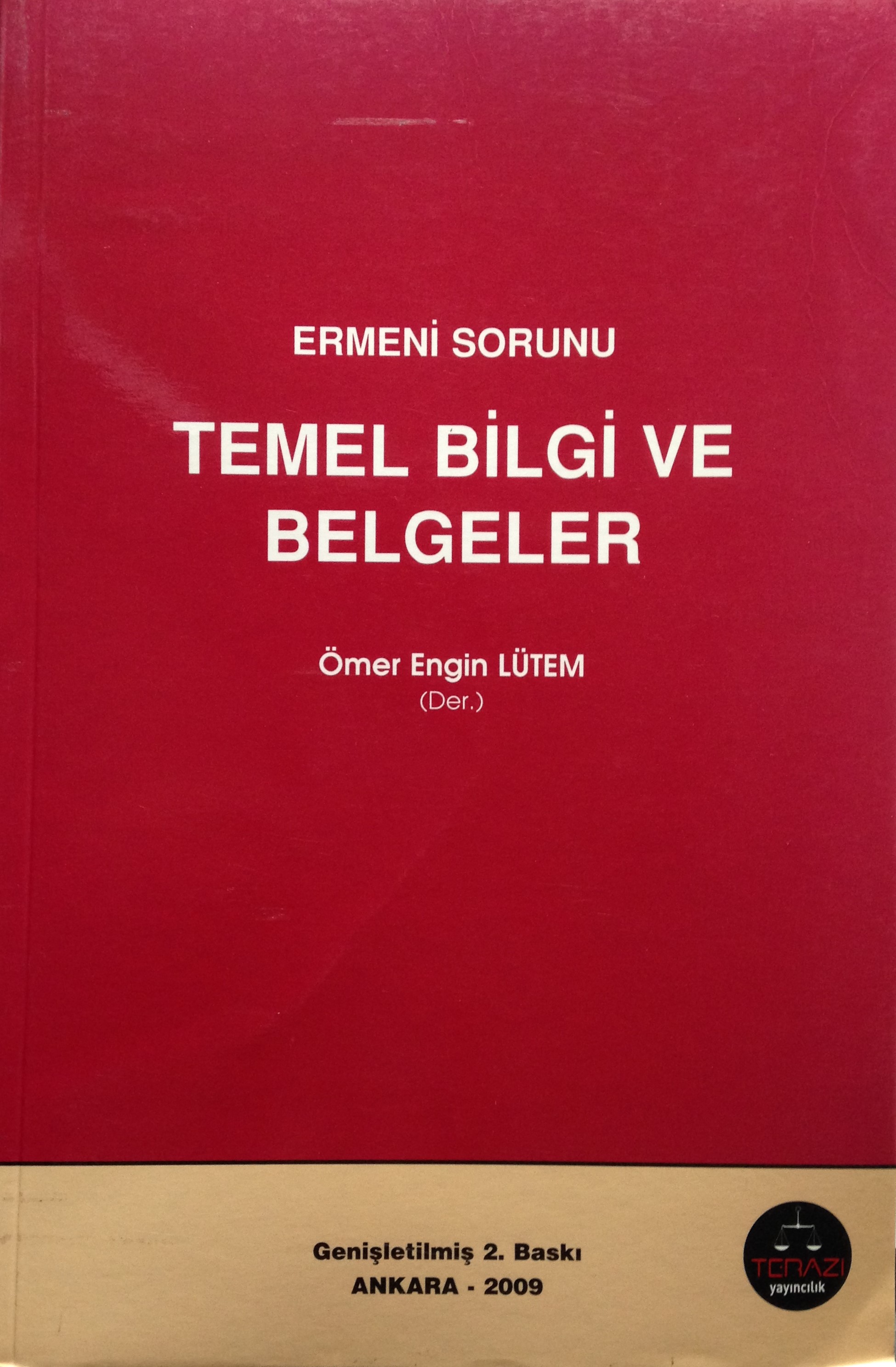
ERMENİ SORUNU - TEMEL BİLGİ VE BELGELER (2. BASKI)
-
AVİM Conference Hall 24.01.2023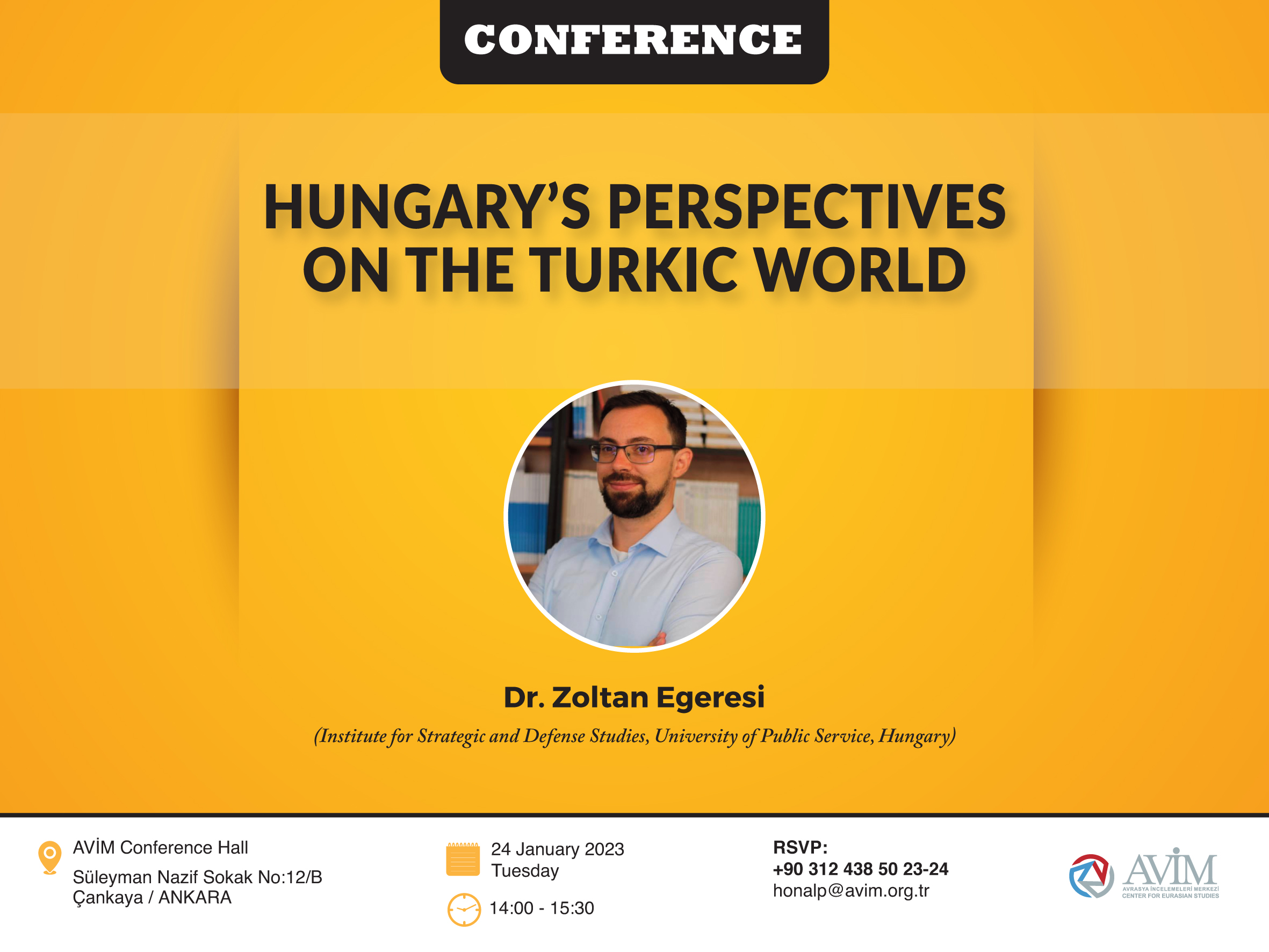
CONFERENCE TITLED “HUNGARY’S PERSPECTIVES ON THE TURKIC WORLD"